2025 AMA Research Challenge – Member Premier Access

October 22, 2025

Virtual only, United States

Would you like to see your presentation here, made available to a global audience of researchers?
Add your own presentation or have us affordably record your next conference.

Background

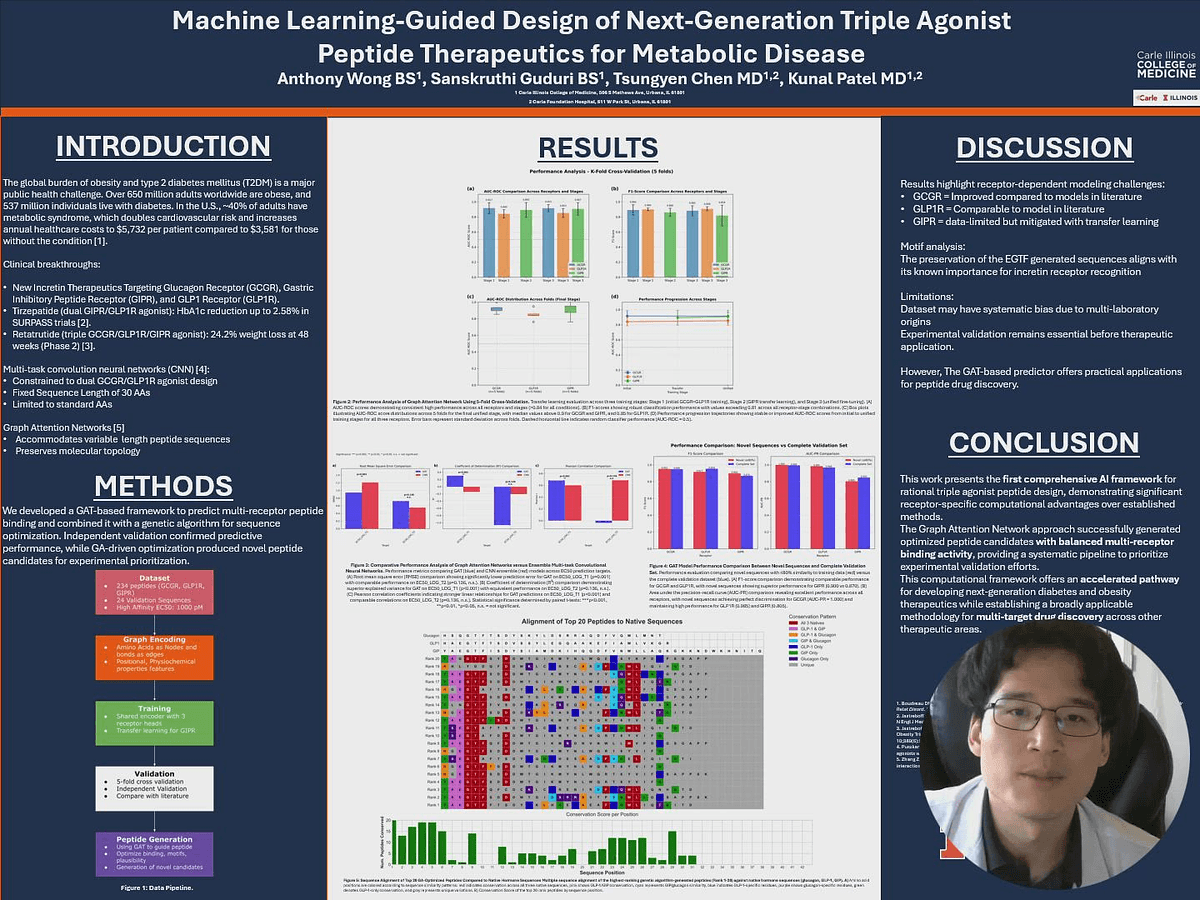
Multi-target peptide therapeutics targeting glucagon receptor (GCGR), glucagon-like peptide-1 receptor (GLP1R), and glucose-dependent insulinotropic polypeptide receptor (GIPR) represent a promising approach for treating diabetes and obesity. Triple agonist peptides demonstrate superior efficacy compared to single-target approaches, yet rational design remains computationally challenging due to complex sequence-structure-activity relationships. Existing methods, primarily based on convolutional neural networks, impose limitations including fixed sequence lengths and inadequate representation of molecular topology. Graph Attention Networks(GAT) offer advantages in capturing molecular structures and variable-length peptide sequences while providing interpretable insights into receptor-specific binding determinants.

Objective

To develop and validate a GAT-based framework for designing novel triple agonist peptides with optimized binding affinity across GCGR, GLP1R, and GIPR, and to compare performance against convolutional neural network approaches. Methods: A dataset of 234 peptide sequences with experimentally determined binding affinities was compiled from multiple sources. Peptides were represented as molecular graphs with seven-dimensional node features encoding physicochemical properties and positional information. The GAT architecture employed a shared encoder with task-specific prediction heads, implementing transfer learning to address limited GIPR training data. Performance was evaluated using 5-fold cross-validation and independent validation on 24 literature-derived sequences. A genetic algorithm framework was developed for peptide sequence optimization, incorporating multi-objective fitness evaluation based on predicted binding affinity, biological plausibility, and sequence novelty.

Results

Cross-validation demonstrated robust GAT performance across all receptors, with GCGR achieving high accuracy (AUC-ROC: 0.915 ± 0.050), followed by GLP1R (AUC-ROC: 0.853 ± 0.059), and GIPR showing acceptable performance despite limited data (AUC-ROC: 0.907 ± 0.083). Comparative analysis revealed receptor-specific advantages: GAT significantly outperformed CNN for GCGR prediction (RMSE: 0.942 vs 1.209, p = 0.0013), while CNN maintained superior GLP1R performance (RMSE: 0.552 vs 0.723). Genetic algorithm optimization achieved substantial improvement over baseline, with 4.0% fitness enhancement and generation of 20 candidates exhibiting mean binding probabilities exceeding 0.5 across all targets.

Conclusions

The GAT-based framework represents a significant advancement in computational peptide design, demonstrating receptor-specific advantages and robust optimization capabilities. Genetic algorithm optimization enables systematic exploration of sequence space while maintaining biological constraints. This approach provides a rational framework for prioritizing experimental validation efforts in triple agonist development.

Downloads

Transcript English (automatic)

Next from 2025 AMA Research Challenge – Member Premier Access

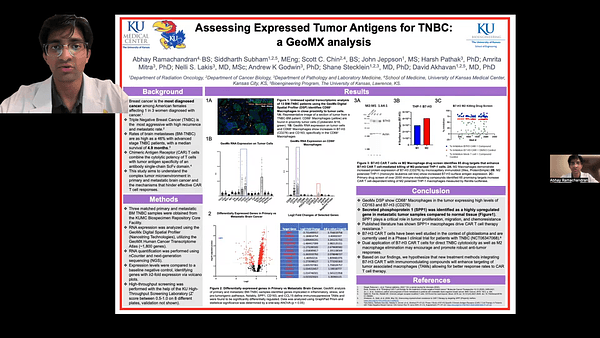
Assessing Expressed Tumor Antigens for TNBC: A GeoMx Analysis

Assessing Expressed Tumor Antigens for TNBC: A GeoMx Analysis

2025 AMA Research Challenge – Member Premier Access

Abhay Ramachandran

22 October 2025

Stay up to date with the latest Underline news!

Select topic of interest (you can select more than one)

PRESENTATIONS

  • All Presentations
  • For Librarians
  • Resource Center
  • Free Trial
Underline Science, Inc.
1216 Broadway, 2nd Floor, New York, NY 10001, USA

© 2025 Underline - All rights reserved