Would you like to see your presentation here, made available to a global audience of researchers?
Add your own presentation or have us affordably record your next conference.
Background
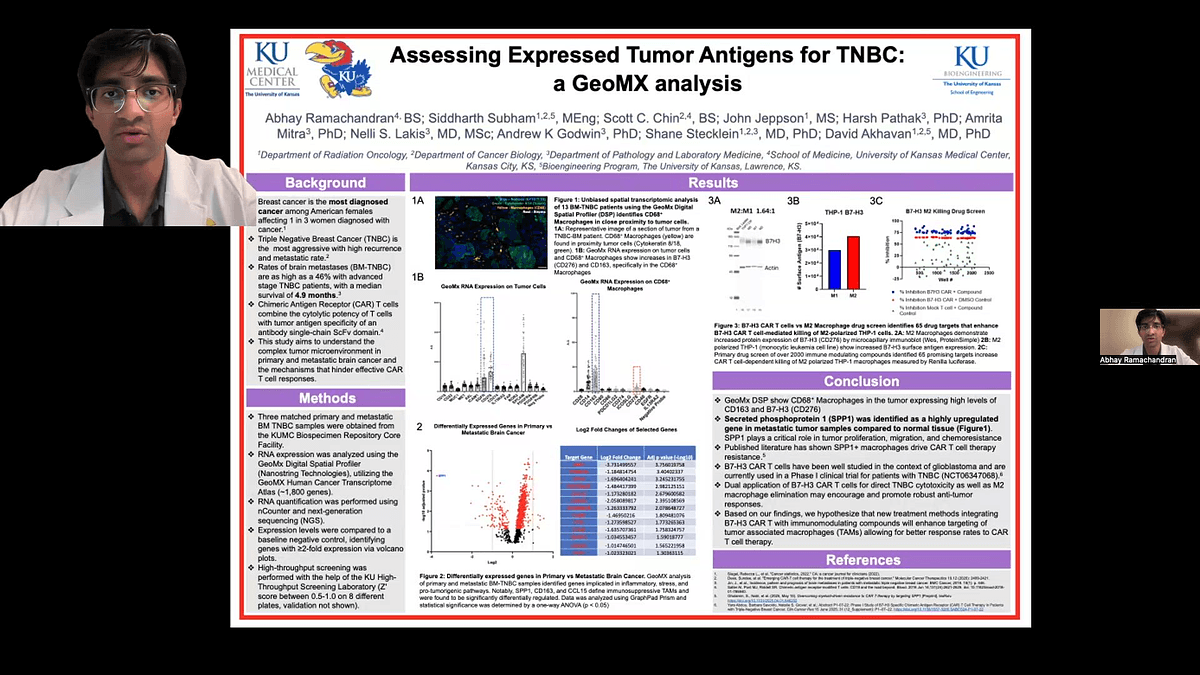
Triple-negative breast cancer (TNBC) is an aggressive subtype of breast cancer with a high recurrence and metastatic rate, leading to a 12% survival rate in patients with metastatic TNBC. Chimeric antigen receptor (CAR) T cell therapy represents a promising therapeutic approach, as it involves genetically modifying T cells by introducing genes encoding a synthetic CAR, which is subsequently expressed on the T cell surface. This modification enables CAR T cells to combine the cytolytic activity of T cells with the antigen-specific recognition ability of a single- chain variable fragment (scFv) domain. This study aims to identify potential gene targets for CAR T cell therapy in brain metastases of TNBC (BM TNBC).
Methods
Matched primary and brain metastatic TNBC tumor samples from three patients were obtained from the KUMC Biospecimen Repository Core Facility. RNA expression profiling was conducted using the GeoMx Digital Spatial Profiler (NanoString Technologies) in the Andrew Godwin Lab at KUMC. Gene expression was analyzed with the GeoMx Human Cancer Transcriptome Atlas (CTA), which quantifies the expression of approximately 1,800 genes. RNA quantification was performed using nCounter and next-generation sequencing (NGS). Differential gene expression was assessed by comparing metastatic tumor samples to a baseline negative control, with genes exhibiting a ≥2-fold increase in expression identified via volcano plots. Statistical significance was determined using one-way ANOVA with multiple comparisons (Prism software, p < 0.05).
Results
Secreted phosphoprotein 1 (SPP1) was identified as a highly upregulated gene in metastatic tumor samples compared to normal tissue. SPP1 plays a critical role in tumor proliferation, migration, and chemoresistance, making it a promising candidate for targeted CAR T cell therapy. In vitro CAR T cell experiments are ongoing to assess the efficacy of SPP1-targeted therapies in eliminating TNBC cells.
Conclusion
This study identifies SPP1 as a highly expressed antigen in BM-TNBC, suggesting its potential as a novel target for CAR T cell therapy. Further investigation through functional assays and animal studies will determine its viability as a therapeutic target in this challenging TNBC subtype.