Premium content
Access to this content requires a subscription. You must be a premium user to view this content.

Would you like to see your presentation here, made available to a global audience of researchers?
Add your own presentation or have us affordably record your next conference.
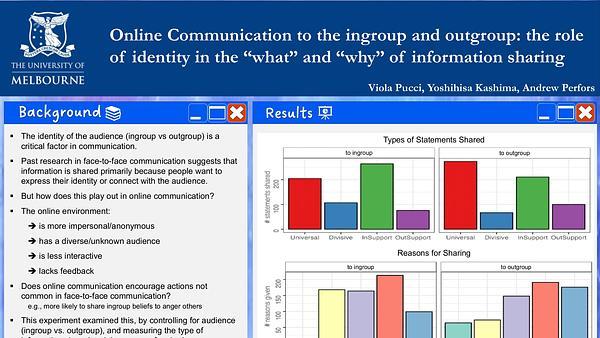
When people share information online, they do so with different intentions (connection, persuasion, etc). However, are these motives always apparent to others? To test this, we put participants (N = 319) in imaginary ingroup and outgroup online forums. In each, people were presented with different types of statements and asked why they thought the poster had shared them, whether they believed the poster was an ingroup or outgroup member, and how much they liked the poster. Although results showed a high degree of heterogeneity, some patterns were present. Preliminary analyses indicate that identity expression was the most common motive attributed to perceived-ingroup posters across statement types, whereas wanting to persuade or anger were also prevalent motives for perceived-outgroup posters. Notably, while wanting to anger was the main motive that made people dislike perceived-ingroup posters, all motives across all statement types resulted in a high proportion of dislike towards perceived-outgroup posters.
Authors:
Viola Pucci: The University of Melbourne; Andrew Perfors: University of Melbourne; Yoshihisa Kashima: University of Melbourne