Premium content
Access to this content requires a subscription. You must be a premium user to view this content.

Would you like to see your presentation here, made available to a global audience of researchers?
Add your own presentation or have us affordably record your next conference.
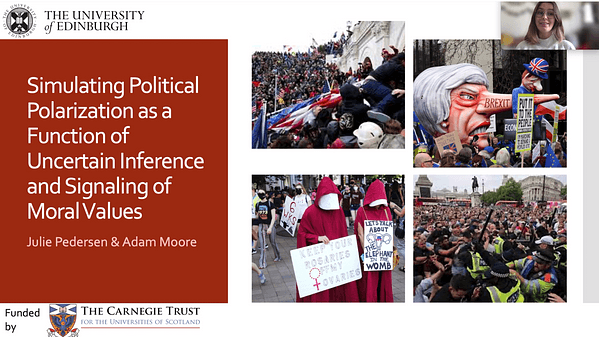
Political polarisation is growing along with its negative consequences – degradation of functional government and increases in stochastic violence. Polarisation can result from both cognitive factors affecting information processing and biased information ecosystems, but their interactions are poorly understood. We present an agent-based model combining a varyingly polarised media landscape with agents driven by homophily and uncertain (political) identity inference processes. Agents were motivated to find similar others to form an ingroup by comparing moral values expressed in response to environmentally imposed moral dilemmas. Media pushed moral values in line with either liberal or conservative values, varying in agreement and influence. Liberal agents were more satisfied (according to homophily motivations), formed larger, more stable clusters, and morally disengaged less than conservatives. Identity aligned media exposure decreased conservative agents’ satisfaction but had no, or the opposite, effect on liberal agents. We conclude that media exposure asymmetrically affects political polarisation across political identities.
Authors:
Julie Maria Ejby Pedersen: University of Edinburgh; Adam Moore: University of Edinburgh