Premium content
Access to this content requires a subscription. You must be a premium user to view this content.

Would you like to see your presentation here, made available to a global audience of researchers?
Add your own presentation or have us affordably record your next conference.
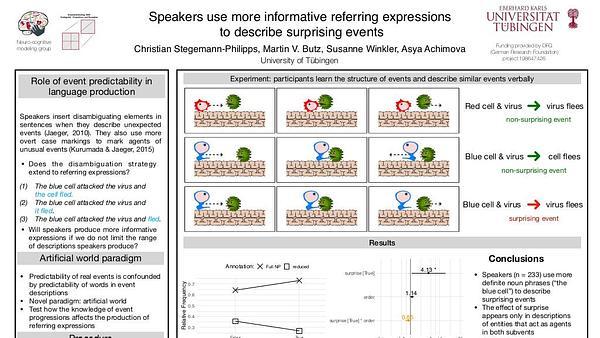
Gricean maxims prescribe cooperative speakers to make their utterances maximally informative so that listeners have the highest chance of understanding the utterances as intended. At the same time, speakers are expected to save articulatory effort and not produce descriptions that are more explicit than necessary. In this work, we first ask how predictability of the described events affects the choice of anaphoric references. We show that speakers prefer phonologically overt descriptions, such as definite NPs, when they refer to agents that behave in an unexpected way. We further test how the interpretation of references changes depending on the listening conditions (low vs.~high noise) and prior expectations about the plausibility of an event. Our work shows that the speaker's extra effort in choosing a more phonologically overt reference is justified by listeners' behavior: they report having heard an utterance which is more plausible than the originally spoken utterance and which contains additional phonological material.
Authors:
Asya Achimova: University of Tübingen; Marjolein van Os: Saarland University; Vera Demberg: Saarland University; Martin V. Butz: University of Tuebingen