Premium content
Access to this content requires a subscription. You must be a premium user to view this content.

Would you like to see your presentation here, made available to a global audience of researchers?
Add your own presentation or have us affordably record your next conference.
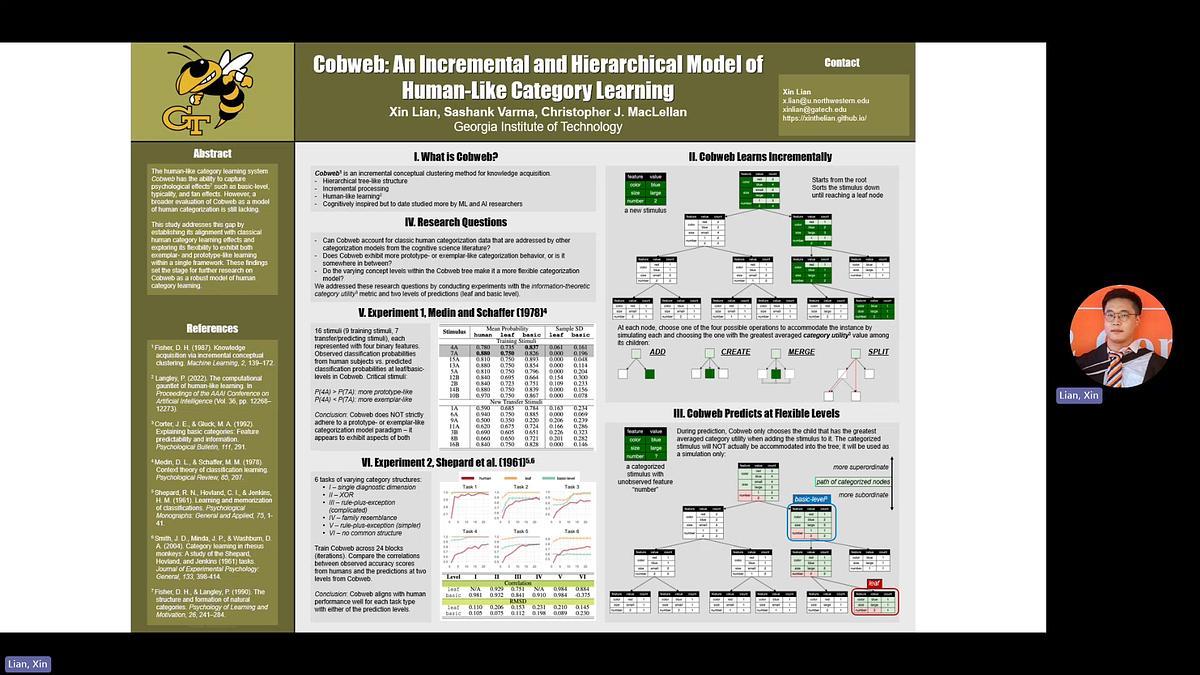
Cobweb, a human-like category learning system, differs from other incremental categorization models in constructing hierarchically organized cognitive tree-like structures using the category utility measure. Prior studies have shown that Cobweb can capture psychological effects such as the basic-level, typicality, and fan effects. However, a broader evaluation of Cobweb as a model of human categorization remains lacking. The current study addresses this gap. It demonstrates Cobweb's alignment with classical human category learning effects. It also explores Cobweb's flexibility to exhibit both exemplar- and prototype-like learning within a single model. These findings set the stage for future research on Cobweb as a comprehensive model of human category learning.
Authors:
Xin Lian: Georgia Institute of Technology; Sashank Varma: Georgia Tech; Christopher MacLellan: Georgia Institute of Technology