Premium content
Access to this content requires a subscription. You must be a premium user to view this content.

Would you like to see your presentation here, made available to a global audience of researchers?
Add your own presentation or have us affordably record your next conference.
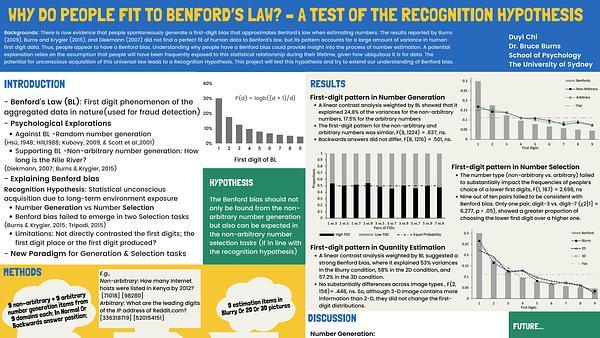
When adults estimate meaningful numbers their distribution of first-digits is strongly biased towards Benford’s Law. Insight into why this bias emerges could be gained by examining when it emerges in children. Three hypotheses were formulated: the Representation Hypothesis predicted this distribution can be found in all grades; the Integration Hypothesis predicted a leap in Benford bias from Grade 3 to 4 due to increased mathematical knowledge; and the Distribution Hypothesis proposed a gradual increase across grades due to implicit learning. 151 children in Grades 2 to 4 were asked to estimate numbers based on images and questions. Results showed a strong Benford bias in all three grades but a significant leap from Grade 2 to 3. This was evidence for both the Representation and Integration Hypotheses. Therefore, Benford bias may develop in children due to how they represent numbers, or develop complex mathematical processes, or perhaps some combination of these.
Authors:
Sophia Wünsch: Goethe University; Regina Vollmeyer: Goethe University; Bruce Burns: The University of Sydney