Premium content
Access to this content requires a subscription. You must be a premium user to view this content.

Would you like to see your presentation here, made available to a global audience of researchers?
Add your own presentation or have us affordably record your next conference.
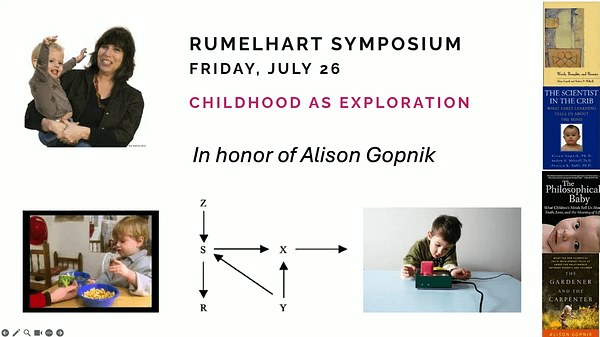
Allison describes three different kinds of cognitive capacities that trade-off against each other, and suggests that they have a distinctive developmental profile. Exploitation, the pursuit of goals, resources and utilities, is characteristic of adult cognition. She will argue however, that two very different kinds of cognition characterize childhood and elderhood. Childhood is characterized by epistemically motivated exploration. In particular, children seek out information about the causal structure of the world. This exploration can be understood computationally as the pursuit of an intrinsic reward called “empowerment" in reinforcement learning. However, forgoing reward for exploration requires support and nurturance from others - it requires care and teaching. Care is particularly characteristic of elders. The intelligence of care has a distinctive structure. It can be best understood as helping currently less capable others to become empowered. The combination of these different kinds of intelligence explains human success.