FROMANNUAL REVIEWS

CogSci 2026

•

•

Rio de Janeiro, Brazil

Increasingly, people encounter health-related claims made by others on social media. When faced with conflicting information, an important question is how people decide which information to share. Selective sharing (e.g., passing on only posts that support a particular claim) may distort others’ perceptions of the balance of opinion. Across two experiments, we examined how communicative goals shape information sharing by asking participants to choose sets of posts to share with different goals in mind. In Experiment 1, we found distinct sharing behaviours across goals, and that when given no explicit goal, people tended to share as if advocating for their preferred stance rather than conveying the balance of opinion in a more nuanced way. Experiment 2 replicated these results even when the balance of opinion opposed people’s own beliefs. This research highlights how biases in information sampling may systematically distort social learning.

Next from CogSci 2026

Fine-tuned Large Language Models predict human word associations and improve performance across lexical and semantic processing tasks.

Fine-tuned Large Language Models predict human word associations and improve performance across lexical and semantic processing tasks.

CogSci 2026

Lea Frermann
Sukai Huang
+1
Simon De Deyne and 3 other authors

Similar lecture

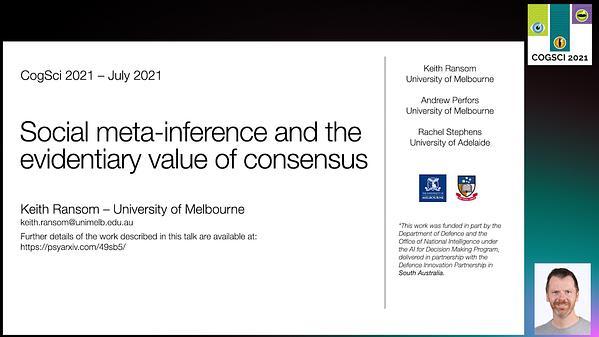
Social meta-inference and the evidentiary value of consensus
technical paper

Social meta-inference and the evidentiary value of consensus

CogSci 2021

Keith Ransom
Keith Ransom and 2 other authors

04 July 2021

Stay up to date with the latest Underline news!

Select topic of interest (you can select more than one)

PRESENTATIONS

  • All Presentations
  • For Librarians
  • Resource Center
  • Free Trial
Underline Science, Inc.
1216 Broadway, 2nd Floor, New York, NY 10001, USA

© 2026 Underline - All rights reserved

This site is protected by reCAPTCHA and the Google Privacy Policy and Terms of Service apply.