keywords:
cellular energy allocation
thermal plasticity
thermal evolution
range expansion
pace-of-life
complex life cycle
antioxidants
oxidative stress
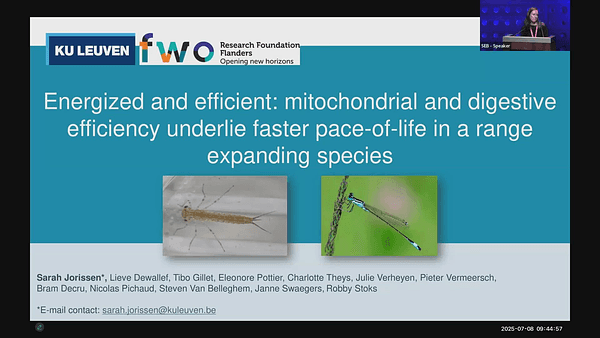
As global warming progresses, organismal pace-of-life (POL) traits evolve in response to shifting climates. Although there is strong support for the POL concept, the mechanisms underlying it are still largely understudied, especially across life stages. Our study assessed whether physiological variables related to the net energy budget and oxidative stress could explain plastic and evolved POL history patterns across thermal regimes. We capitalized on the southward range expansion of damselfly Ischnura elegans, from France into warmer regions of Spain. Alongside the ancestral French region, we studied two Spanish regions: a ‘new edge’ region founded 10 years ago (Salamanca) and an ‘old edge’ region founded 70 years ago (Murcia-Alicante). In a common garden experiment, larvae and adults from all regions were exposed to French and Spanish summer temperatures. Our results confirm that old edge Spanish, fast-paced, larvae evolved a higher net energy budget than the, slower-paced, ancestral region under Spanish temperatures. In contrast to theory, they evolved a faster POL history without suffering more oxidative damage. Conversely, new edge Spanish larvae did not evolve yet these physiological changes in the net energy budget and oxidative damage, matching absence of evolution of a faster POL in this region. The net energy budget increased in larvae across all regions but decreased in adults, suggesting an upper limit to energy allocation. In conclusion, our findings indicate that evolutionary changes in energy budget, rather than oxidative costs, explain POL evolution under warming conditions, although this pattern was life-stage dependent.