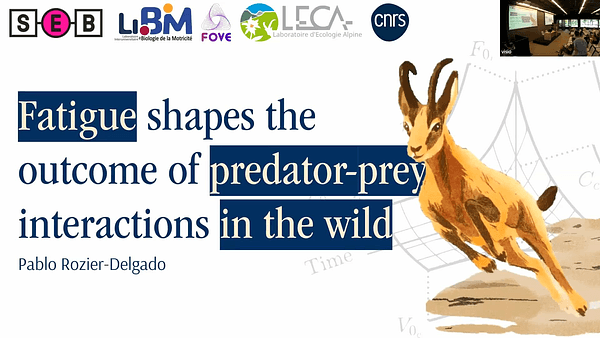
Predator-prey interactions drive the evolution of functional locomotor strategies, yet survival hinges on a dynamic bio-physical coupling where intense exertion triggers fatigue. This fatigue is defined as the progressive reduction of muscle and locomotor mechanical capacity when operating above a critical threshold. To bridge the gap between deterministic models and the inaccessibility of internal states in wild fauna, we treated Homo sapiens as a model organism, leveraging the accessibility of their physiological data and their willingness to participate in somewhat improbable studies, to reveal universal principles of animal movement. We characterised the Force-Velocity-Endurance phenotype of 16 athletes using the validated RACLET protocol to determine individual critical speeds, the threshold above which fatigue occurs, and fatigability rate constants. Participants performed 50 dyadic "Chase Tag" interactions, simulating ambush and cursorial scenarios monitored by high-frequency GPS. From these real-life simulations, we extracted indices including mean speed, curviness, and tangential and radial accelerations. Instantaneous fatigue was computed via a unified mathematical framework and validated against post-chase maximal sprints, demonstrating a strong correlation (r=0.80) with null systematic bias and low random error (13.1%). These validated physical capacities were then integrated into a bespoke video game simulation that fuses realistic physics with animal bio-energetics. By replaying chases numerically, we found that digital kinematic indices matched real-world metrics, confirming the simulation's representativeness. Unlike purely algorithmic models, this approach preserves biological decision-making complexity through human-in-the-loop perception. Leveraging our methods for evaluating animal capacities in natura, we can now create accurate avatars to study predation within controlled, simulated environments.