AAAI 2026

January 25, 2026

Singapore, Singapore

Would you like to see your presentation here, made available to a global audience of researchers?
Add your own presentation or have us affordably record your next conference.

As scaling up training data has significantly improved the general multimodal capabilities of Large Vision-Language Models (LVLMs), they still suffer from the hallucination issue, generating text that is inconsistent with the visual input. This phenomenon motivates us to systematically investigate the role of training data in hallucination. We introduce a new benchmark, POPEv2, which consists of counterfactual images collected from the training data of LVLMs with certain objects masked. Through comprehensive evaluation on POPEv2, we find that current LVLMs suffer from training bias: they fail to fully leverage their training data and hallucinate more frequently on images seen during training. Specifically, they perform poorly on counterfactual images, often incorrectly answering “Yes” to questions about masked objects. To understand this issue, we conduct probing experiments on the models’ internal components, revealing that this training bias is primarily located in the language modeling (LM) head, which fails to correctly translate accurate visual representations into textual outputs. Based on these findings, we propose Obliviate, an efficient and lightweight unlearning method designed to mitigate object hallucination via training bias unlearning. Obliviate identifies the discrepancy between ground-truth labels and model outputs on the training data as a proxy for bias and adopts a parameter- and data-efficient fine-tuning strategy that only updates the LM head. Extensive experiments demonstrate the effectiveness of our approach. While only reusing the training data and updating approximately 2\% of the parameters, Obliviate significantly reduces hallucination across both discriminative and generative tasks. Furthermore, it demonstrates strong scalability with respect to both model size (2B to 72B) and training data volume, and exhibits promising generalization to hallucination types beyond object-level hallucination. Our code and data will be publicly released.

Downloads

SlidesPaperTranscript English (automatic)

Next from AAAI 2026

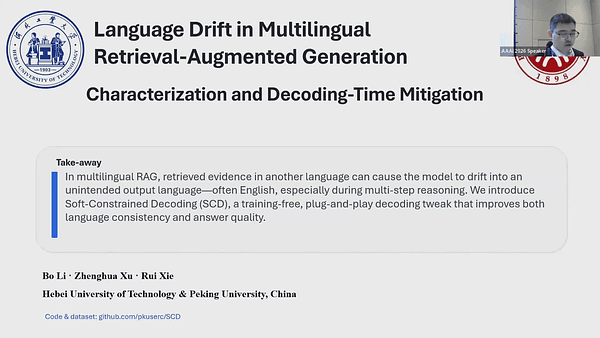
Language Drift in Multilingual Retrieval-Augmented Generation: Characterization and Decoding-Time Mitigation
technical paper

Language Drift in Multilingual Retrieval-Augmented Generation: Characterization and Decoding-Time Mitigation

AAAI 2026

Rui XieBo Li
Bo Li and 2 other authors

25 January 2026

Stay up to date with the latest Underline news!

Select topic of interest (you can select more than one)

PRESENTATIONS

  • All Presentations
  • For Librarians
  • Resource Center
  • Free Trial
Underline Science, Inc.
1216 Broadway, 2nd Floor, New York, NY 10001, USA

© 2025 Underline - All rights reserved