AAAI 2026

January 25, 2026

Singapore, Singapore

Would you like to see your presentation here, made available to a global audience of researchers?
Add your own presentation or have us affordably record your next conference.

Multilingual Retrieval-Augmented Generation (RAG) enables large language models (LLMs) to perform knowledge-intensive tasks across languages by leveraging retrieved documents as external evidence. However, when the retrieved evidence differs in language from the user query and in-context exemplars, the model often exhibits language drift by generating responses in an unintended language. This phenomenon is especially pronounced during reasoning-heavy decoding, such as Chain-of-Thought (CoT) generation, where intermediate steps introduce further language instability. In this paper, we systematically study output language drift in multilingual RAG across multiple datasets, languages, and LLM backbones. Our controlled experiments reveal that the drift is not caused by comprehension failure, but by decoder-level collapse, where dominant token distributions and high-frequency English patterns override the intended generation language. We further observe that English acts as a semantic attractor under cross-lingual conditions, emerging as both the strongest interference source and the most frequent fallback language. To mitigate this, we propose Soft Constrained Decoding (SCD), a lightweight, training-free decoding strategy that gently steers generation toward the target language by penalizing non-target-language tokens. SCD is model-agnostic and can be applied to any generation algorithm without modifying architecture or requiring additional data. Experiments across three multilingual datasets and multiple typologically diverse languages show that SCD consistently improves language alignment and task performance, providing an effective and generalizable solution to a long-standing yet underexplored challenge in multilingual RAG.

Downloads

SlidesPaperTranscript English (automatic)

Next from AAAI 2026

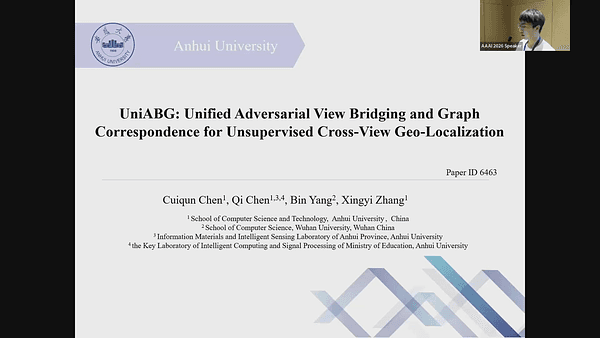
UniABG: Unified Adversarial View Bridging and Graph Correspondence for Unsupervised Cross-View Geo-Localization
technical paper

UniABG: Unified Adversarial View Bridging and Graph Correspondence for Unsupervised Cross-View Geo-Localization

AAAI 2026

+1
Cuiqun Chen and 3 other authors

25 January 2026

Stay up to date with the latest Underline news!

Select topic of interest (you can select more than one)

PRESENTATIONS

  • All Presentations
  • For Librarians
  • Resource Center
  • Free Trial
Underline Science, Inc.
1216 Broadway, 2nd Floor, New York, NY 10001, USA

© 2025 Underline - All rights reserved