2025 AMA Research Challenge – Member Premier Access

October 22, 2025

Virtual only, United States

Would you like to see your presentation here, made available to a global audience of researchers?
Add your own presentation or have us affordably record your next conference.

Background

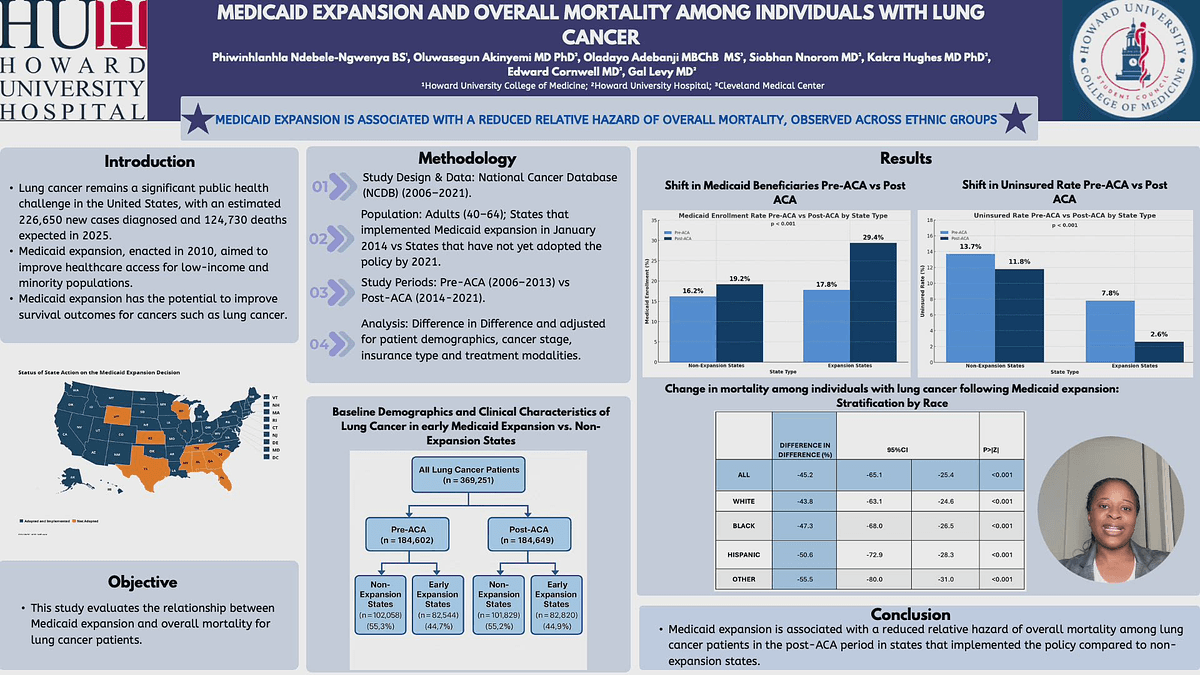
Lung cancer is the leading cause of cancer-related mortality in the United States, with outcomes disproportionately worse among uninsured and socioeconomically disadvantaged populations. The Affordable Care Act (ACA), through Medicaid expansion, sought to improve access to care, yet its long-term impact on lung cancer survival remains incompletely defined.

Objective

To evaluate the association between Medicaid expansion and overall mortality in patients with lung cancer, and to determine whether effects varied by stage at diagnosis, race/ethnicity, socioeconomic status, and treatment modality.

Methods

We conducted a retrospective cohort study using the National Cancer Database, including patients aged 40–64 years diagnosed with lung cancer between 2006 and 2021. States were categorized as early Medicaid expansion (by January 2014) or non-expansion. The study period was divided into pre-expansion (2006–2013) and post-expansion (2014–2021). A Difference-in-Differences (DiD) analytic approach within a Cox proportional hazards framework was used to estimate the effect of Medicaid expansion on all-cause mortality, adjusting for demographic, clinical, and socioeconomic factors.

Results

The study cohort comprised 369,251 patients, predominantly White (74.7%) and male (52.7%), with a mean age of 56.8 ± 5.6 years. A total of 165,364 individuals (44.8%) resided in early Medicaid expansion states. Medicaid expansion was associated with a 45.2% reduction in overall mortality. Stratified analyses demonstrated reductions in the hazard of overall mortality across all racial and ethnic groups, with the greatest benefit observed among Hispanic patients (DID: –0.506; 95% CI, –0.729 to –0.283; p < 0.001). Expansion states also showed increased early-stage diagnoses, reduced uninsured rates, and higher surgical utilization following the ACA.

Conclusions

Medicaid expansion was significantly associated with improved lung cancer survival across demographic and clinical subgroups. These findings underscore the role of insurance policy in shaping oncologic outcomes and suggest that Medicaid expansion may serve as a critical strategy to enhance access to timely diagnosis and treatment.

Downloads

Transcript English (automatic)

Next from 2025 AMA Research Challenge – Member Premier Access

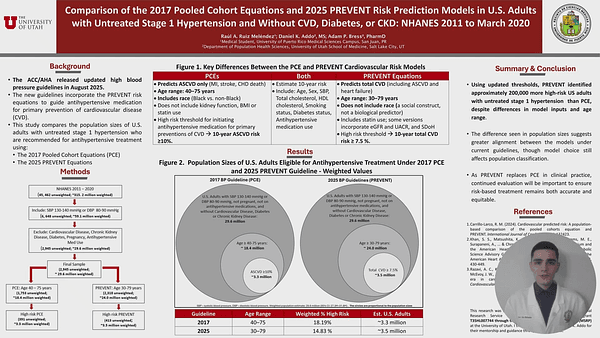
Comparison of the 2017 Pooled Cohort Equations and 2025 PREVENT Risk Prediction Models in U.S. Adults with Untreated Stage 1 Hypertension and Without CVD, Diabetes, or CKD: NHANES 2011 to March 2020

Comparison of the 2017 Pooled Cohort Equations and 2025 PREVENT Risk Prediction Models in U.S. Adults with Untreated Stage 1 Hypertension and Without CVD, Diabetes, or CKD: NHANES 2011 to March 2020

2025 AMA Research Challenge – Member Premier Access

Raul A. Ruiz Melendez

22 October 2025

Stay up to date with the latest Underline news!

Select topic of interest (you can select more than one)

PRESENTATIONS

  • All Presentations
  • For Librarians
  • Resource Center
  • Free Trial
Underline Science, Inc.
1216 Broadway, 2nd Floor, New York, NY 10001, USA

© 2025 Underline - All rights reserved