Would you like to see your presentation here, made available to a global audience of researchers?
Add your own presentation or have us affordably record your next conference.
Background & Objectives
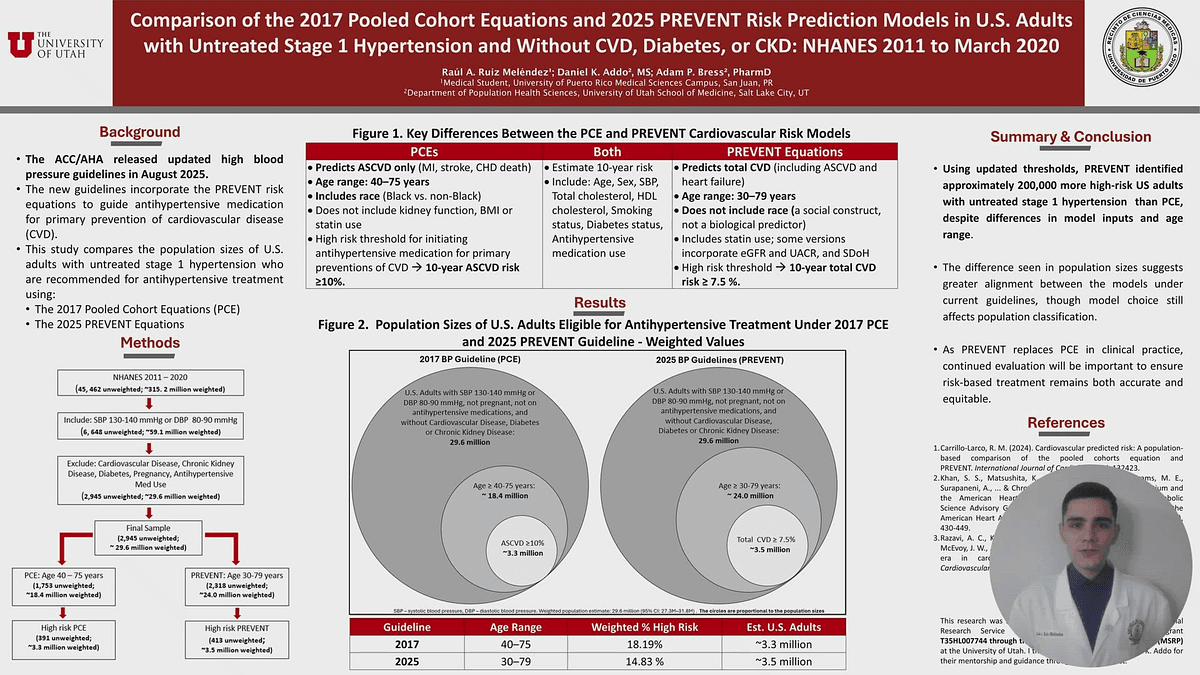
The 2025 ACC/AHA hypertension guidelines incorporate the Predicting Risk of Cardiovascular Disease Events (PREVENT) equations to guide the initiation of antihypertensive medications for primary prevention of cardiovascular disease (CVD). This study aimed to compare population sizes recommended for antihypertensive treatment according to primary prevention criteria from the 2017 versus 2025 guidelines.
Methods
Using NHANES data (2011–2020), we identified participants aged 30–79 years who had systolic blood pressure (SBP) of 130–140 mmHg or diastolic blood pressure (DBP) of 80–90 mmHg, and who had no prior diagnosis of hypertension, CVD, diabetes, or chronic kidney disease, and were not pregnant nor taking antihypertensive medication. We estimated the 10-year risk for each participant using the Pooled Cohort Equations (PCE; stroke and myocardial infarction for those aged 40–75 years) and the PREVENT base model for total CVD (stroke, MI, and heart failure for those aged 30–79 years). High risk was defined as a 10-year ASCVD risk ≥10% with PCE and total CVD risk ≥7.5% with PREVENT. Analyses incorporated NHANES sampling weights to generate nationally representative estimates.
Results
The initial population for both analyses included 29.6 million U.S. adults with SBP 130–140 mmHg or DBP 80–90 mmHg, not on antihypertensive medication, not pregnant and without CVD, diabetes, or chronic kidney disease. Of these, 18.4 million were aged 40–75 years and thus eligible for risk assessment with PCE; among these, 3.3 million had a 10-year ASCVD risk ≥10%. In contrast, 24.0 million were aged 30–79 years and thus eligible for total CVD risk assessment using the PREVENT model; of these, 3.5 million had a 10-year PREVENT base total CVD risk ≥7.5%.
Conclusion
Under the updated thresholds, PREVENT identified nearly 200,000 more high-risk U.S. adults with untreated stage 1 hypertension than PCE, despite differences in model inputs and age range.