Would you like to see your presentation here, made available to a global audience of researchers?
Add your own presentation or have us affordably record your next conference.
Background
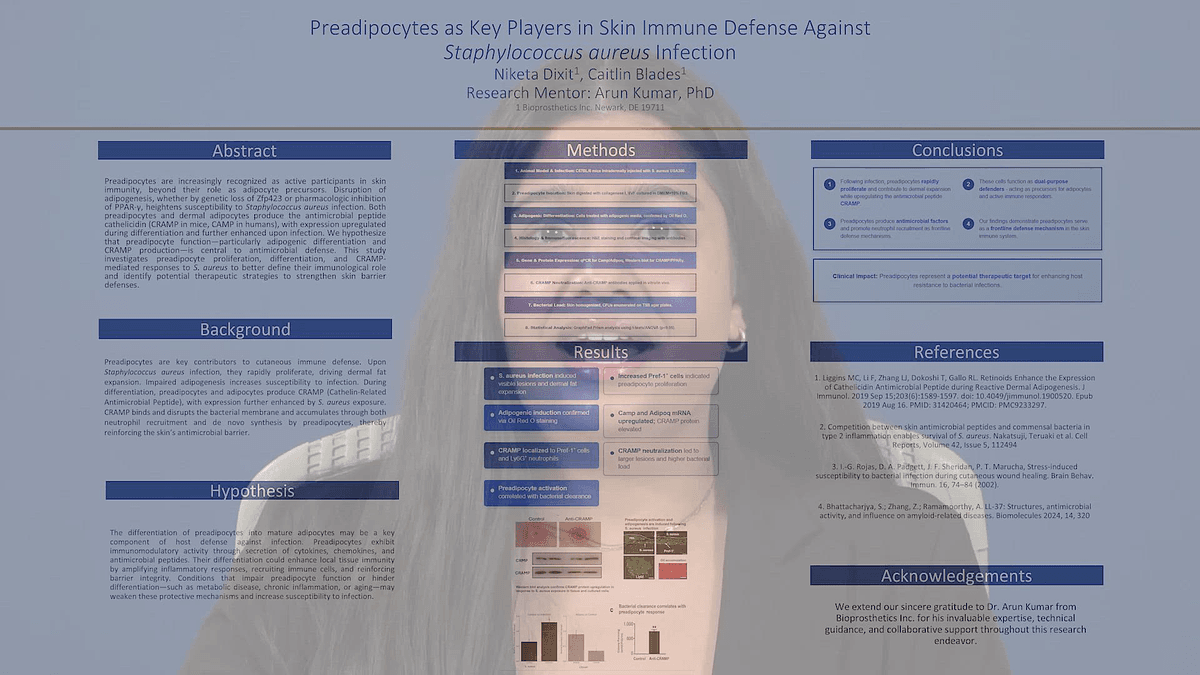
Preadipocytes play a central role in skin immune defense. In response to Staphylococcus aureus infection, they rapidly proliferate, leading to dermal fat expansion. When adipogenesis is impaired, susceptibility to infection increases. During differentiation, preadipocytes and adipocytes produce cathelicidin (CRAMP in mice, CAMP in humans), a vital antimicrobial peptide whose expression is further upregulated by S. aureus exposure. CRAMP accumulates through both neutrophil recruitment and de novo synthesis by preadipocytes, strengthening the skin’s antimicrobial response.
Methods
C57BL/6 mice were intradermally injected with S. aureus USA300. Preadipocytes were isolated from digested dorsal skin, cultured, and induced to differentiate. Oil Red O staining confirmed adipogenesis. Skin sections underwent H&E and immunofluorescence staining for Pref-1, CRAMP, and Ly6G. Gene expression (Camp, Adipoq, inflammatory markers) was measured by qPCR; protein levels were assessed via Western blotting. CRAMP function was evaluated using neutralizing antibodies in vitro and in vivo. Bacterial burden was determined through CFU counts. Data were analyzed using unpaired t-tests or ANOVA (p < 0.05).
Results
In vivo, infection triggered visible skin lesions and dermal fat layer expansion within 24–72 hours. Histology and immunofluorescence confirmed increased Pref-1⁺ preadipocytes in infected dermis. Isolated preadipocytes differentiated into lipid-rich adipocytes in vitro. qPCR showed significant upregulation of Camp and Adipoq in infected tissue; Western blotting confirmed increased CRAMP protein levels. CRAMP localized to both Pref-1⁺ cells and Ly6G⁺ neutrophils, indicating dual sources. Neutralizing CRAMP resulted in larger lesions and higher bacterial burden (p < 0.01), while in vitro inhibition reduced bactericidal activity. Mice with stronger preadipocyte responses exhibited lower CFUs, linking preadipocyte activation to bacterial clearance.
Conclusion
Preadipocytes play a critical role in the skin’s immune defense against S. aureus. Beyond serving as adipocyte precursors, they actively contribute to antimicrobial defense through CRAMP production and support of neutrophil recruitment. Their activation and differentiation are essential for limiting infection and promoting bacterial clearance. These findings position preadipocytes as immunologically active cells and potential therapeutic targets to enhance host resistance to bacterial skin infections.