2025 AMA Research Challenge – Member Premier Access

October 22, 2025

Virtual only, United States

Would you like to see your presentation here, made available to a global audience of researchers?
Add your own presentation or have us affordably record your next conference.

Background

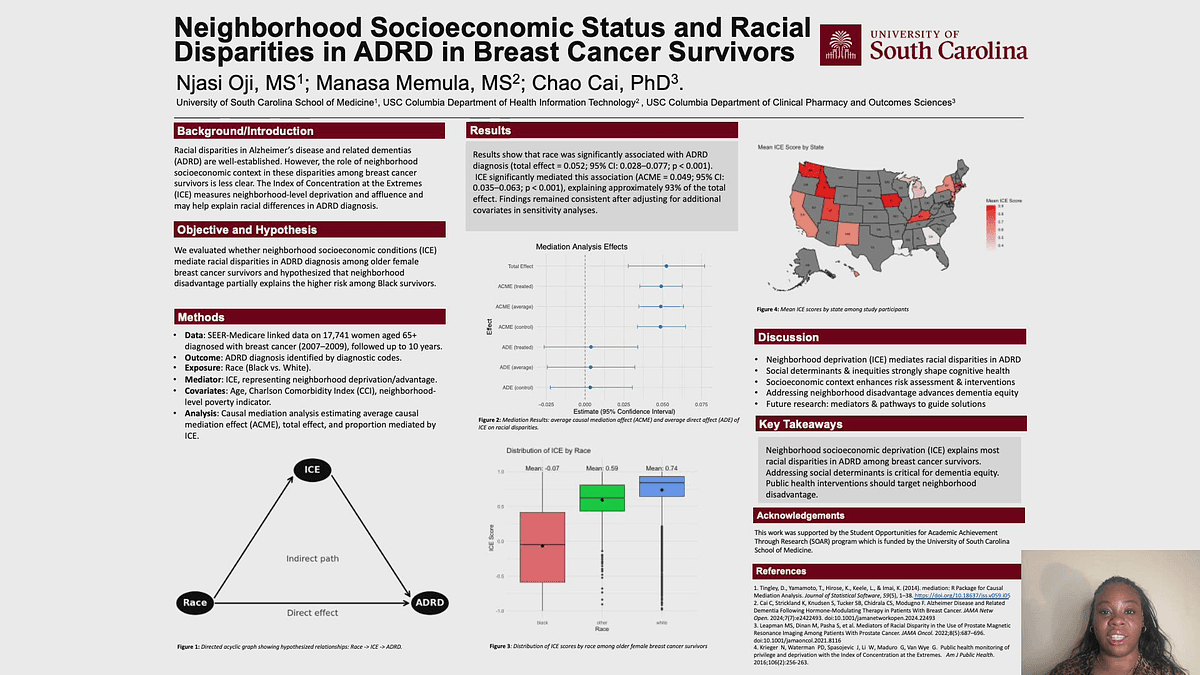
Racial disparities in Alzheimer’s disease and related dementias (ADRD) are well-documented, yet the contribution of neighborhood socioeconomic context to these disparities among breast cancer survivors remains unclear. The Index of Concentration at the Extremes (ICE) captures neighborhood-level deprivation and affluence, potentially mediating racial differences in ADRD diagnosis. Understanding the role of neighborhood-level factors may explain mechanisms behind these disparities.

Objective

To assess whether neighborhood-level socioeconomic conditions, measured by ICE, mediate the racial disparity in ADRD diagnosis among older female breast cancer survivors.

Methods

We analyzed SEER-Medicare linked data from 17,741 women aged 65 and older diagnosed with breast cancer (2007–2009) with up to 10 years of follow-up. ADRD diagnosis was identified through diagnostic codes. We conducted causal mediation analysis to estimate the average causal mediation effect (ACME), total effect, and proportion mediated by ICE on the association between race (Black vs. White) and ADRD diagnosis, adjusting for age, comorbidities using the Charlson Comorbidity Index (CCI), treatment type, and neighborhood -level poverty indicator.

Results

Race was significantly associated with ADRD diagnosis (total effect estimate = 0.052, 95% CI 0.028–0.077, p < 0.001). ICE significantly mediated this association, with an ACME of 0.049 (95% CI 0.035–0.063, p < 0.001), explaining approximately 93% of the total effect. This strongly suggests that neighborhood-level deprivation/advantage (ICE) explains most of the racial disparity in ADRD diagnoses in the dataset, after adjusting for age, neighborhood-level poverty indicator, treatment type, and CCI. The mediation findings remained robust in sensitivity analyses adjusting for additional covariates.

Conclusion

Neighborhood-level deprivation, as captured by ICE, substantially mediates racial disparities in ADRD diagnosis among breast cancer survivors, highlighting the critical role of social determinants and structural inequities on cognitive health outcomes. These findings suggest that beyond biological factors, such as hormone-modulating therapy-related cognitive effects, social context profoundly shapes racial disparities in cognitive health outcomes. This study shows the importance of neighborhood socioeconomic context in understanding racial disparities in ADRD diagnosis among breast cancer survivors. Further analyses incorporating additional covariates and stratified mediation will clarify the pathways influencing these disparities. Targeted interventions addressing neighborhood disadvantage may be essential for advancing equity in dementia prevention and care.

Downloads

Transcript English (automatic)

Next from 2025 AMA Research Challenge – Member Premier Access

A proteomic signature of vascular disease is associated with the aging brain's vulnerability to degeneration preceding accumulation of amyloid pathology

A proteomic signature of vascular disease is associated with the aging brain's vulnerability to degeneration preceding accumulation of amyloid pathology

2025 AMA Research Challenge – Member Premier Access

Jonah Keller
Jonah Keller

22 October 2025

Stay up to date with the latest Underline news!

Select topic of interest (you can select more than one)

PRESENTATIONS

  • All Presentations
  • For Librarians
  • Resource Center
  • Free Trial
Underline Science, Inc.
1216 Broadway, 2nd Floor, New York, NY 10001, USA

© 2025 Underline - All rights reserved