2025 AMA Research Challenge – Member Premier Access

October 22, 2025

Virtual only, United States

Would you like to see your presentation here, made available to a global audience of researchers?
Add your own presentation or have us affordably record your next conference.

Background

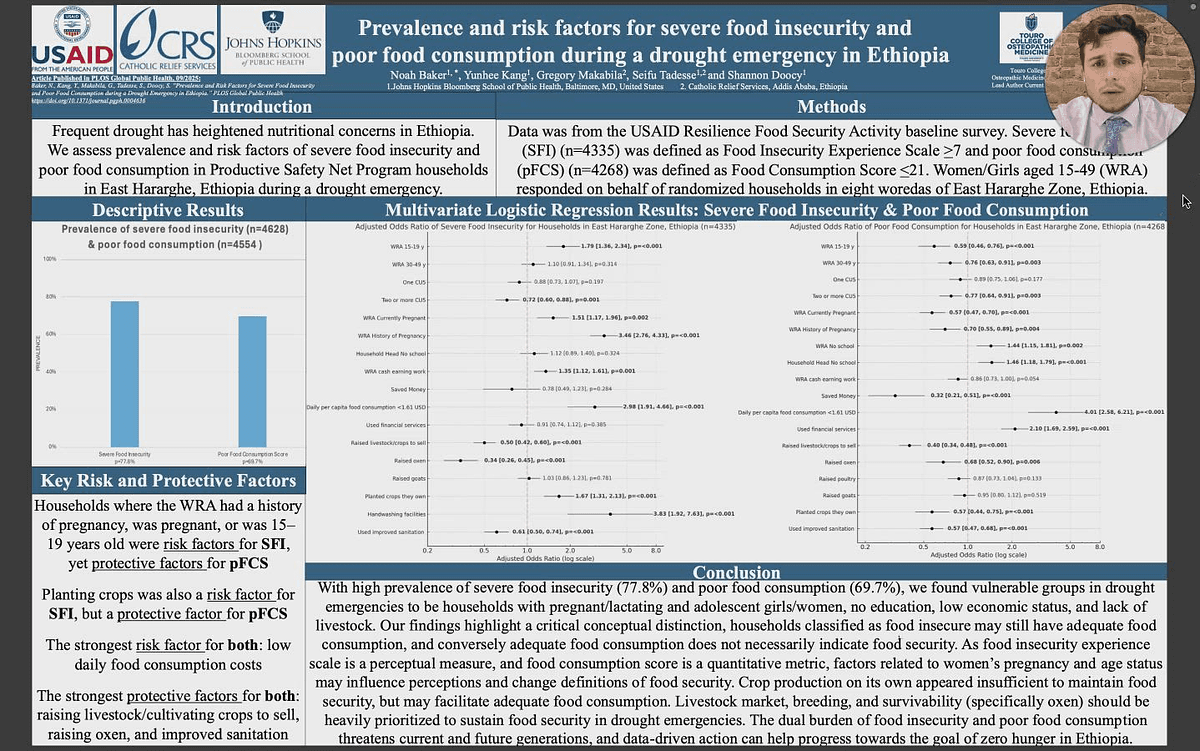
Frequent drought has heightened nutritional concerns in Ethiopia. This study assesses the prevalence and risk factors of severe food insecurity and poor food consumption in Productive Safety Net Programme households in drought-prone East Hararghe, Ethiopia.

Methods

Data was from the USAID-funded Resilience Food Security Activity baseline survey in East Hararghe, Ethiopia. Severe food insecurity (n=4628; multivariate n=4335) was defined as Food Insecurity Experience Scale (>7) and poor food consumption (n=4554; multivariate n=4268) was defined as Food Consumption Score (<21). Logistic regression identified adjusted odds ratio and 95% confidence interval of risk and protective factors.

Results

Severe food insecurity prevalence was 77.79% and poor food consumption was 69.74%. Risk factors for severe food insecurity included women/girls aged 15-19 (1.79; 1.36-2.34), current pregnancy (1.52; 1.17-1.96), history of pregnancy (3.46; 2.76-4.33), cash-earning work (1.35; 1.12-1.61), daily-per-capita food consumption <1.61USD (2.98; 1.91-4.66), crop-planting (1.67; 1.31-2.13), and handwashing facilities (3.83; 1.92-7.63); protective factors included two or more children-under-5 (0.72; 0.60-0.88), raising livestock/crops to sell (0.50; 0.42-0.60), and raising oxen (0.34; 0.26-0.45). Risk factors for poor food consumption included woman/girl (1.44; 1.15-1.81) and household-head no education (1.46; 1.18-1.79), daily-per-capita food consumption <1.61USD (4.01; 2.58-6.21), and financial services (2.10; 1.69-2.59); protective factors included women/girls aged 15-19 (0.59; 0.46-0.76) and 30-49 (0.76; 0.63-0.91), two or more children-under-5 (0.77; 0.64-0.91), current pregnancy (0.57; 0.47-0.70), history of pregnancy (0.70; 0.55-0.89), crop-planting (0.57; 0.44-0.75), raising livestock/crops to sell (0.40; 0.34-0.48) and raising oxen (0.68; 0.52-0.90).

Conclusion

With high severe food insecurity and poor food consumption prevalence, we identified vulnerable households in drought emergencies as those with pregnant/lactating women, mothers, adolescent girls/women, no education and/or livestock. Notably, households where the WRA respondent was pregnant, had been pregnant, was 15-19 years old, and/or planted crops were more likely to experience severe food insecurity, yet less likely to have poor food consumption. Our findings highlight a conceptual distinction, that women/girls’ pregnancy and/or age status may influence household perception and/or definitions of food security despite adequate consumption. The strongest predictor of severe food insecurity and poor food consumption was daily-per-capita food consumption costs <1.61 USD, and the strongest protectors were households that raised livestock/crops to sell and/or raised oxen. Although crop production appeared insufficient to maintain food security, this may improve food consumption score by increased diversity of nutrient intake. The dual burden of food insecurity and poor consumption threatens current and future generations, and data-driven action can help progress towards the goal of zero hunger in Ethiopia.

Downloads

Transcript English (automatic)

Next from 2025 AMA Research Challenge – Member Premier Access

Preadipocytes as Key Players in Skin Immune Defense Against Staphylococcus aureus Infection

Preadipocytes as Key Players in Skin Immune Defense Against Staphylococcus aureus Infection

2025 AMA Research Challenge – Member Premier Access

Niketa Dixit

22 October 2025

Stay up to date with the latest Underline news!

Select topic of interest (you can select more than one)

PRESENTATIONS

  • All Presentations
  • For Librarians
  • Resource Center
  • Free Trial
Underline Science, Inc.
1216 Broadway, 2nd Floor, New York, NY 10001, USA

© 2025 Underline - All rights reserved