2025 AMA Research Challenge – Member Premier Access

October 22, 2025

Virtual only, United States

Would you like to see your presentation here, made available to a global audience of researchers?
Add your own presentation or have us affordably record your next conference.

Background

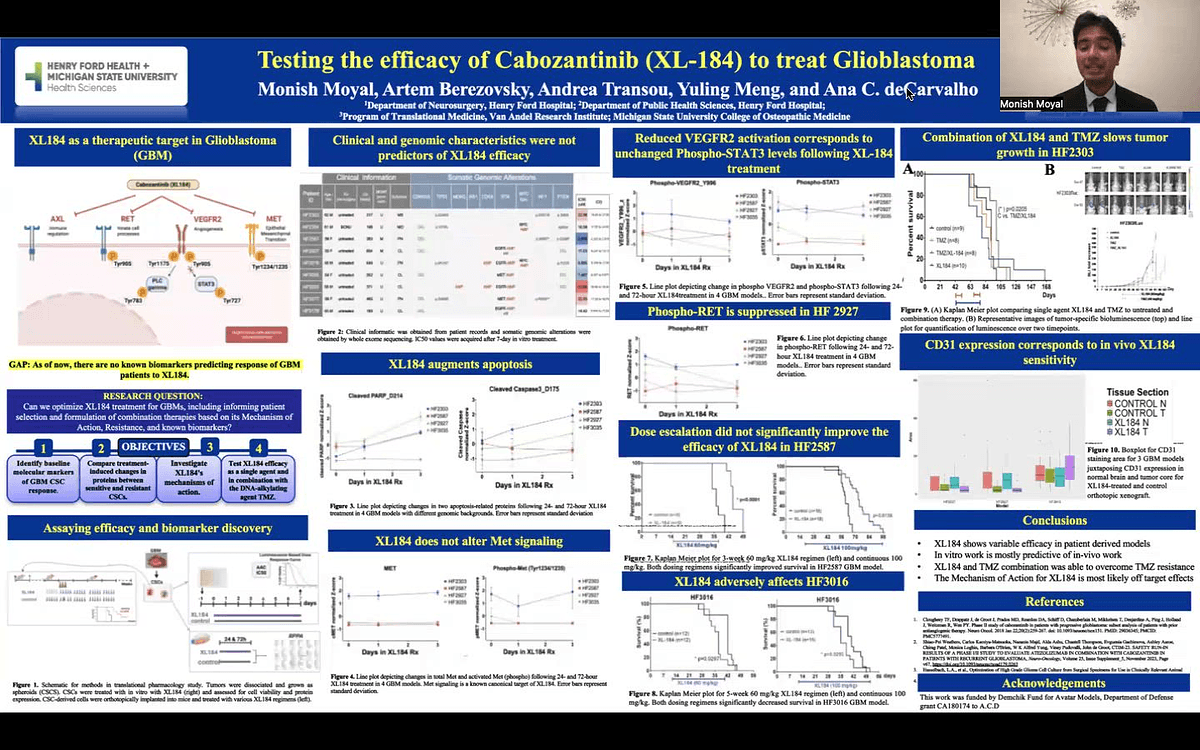
Glioblastoma (GBM) is a highly aggressive malignancy with limited therapeutic advancements despite extensive research. Receptor tyrosine kinase (RTK) amplification, a common feature in glioblastoma (GBM), drives tumor growth/recurrence, therapeutic resistance, and invasion, making RTKs attractive therapeutic targets. Currently, Bevacizumab, the only FDA-approved RTK inhibitor in GBM, improves progression-free survival in patients through vascular normalization. This study evaluates the efficacy of cabozantinib (XL184), a multi-kinase inhibitor targeting various RTKs such as VEGFR2, MET, and AXL, in GBM cancer stem cells (CSCs) and patient-derived xenograft (PDX) models, with a focus on uncovering resistance mechanisms and identifying opportunities for combination therapies.

Methods

Nine genomically diverse GBM CSCs were treated with XL184 to assess drug sensitivity. Reverse Phase Protein Array (RPPA) Proteomics at 24h and 72h was used to evaluate changes in key signaling pathways along with a focused analysis of RTK signaling changes. CSC-derived PDX from two proneural (HF2587, HF3016) and one classical (HF2927) GBM were treated with XL184 monotherapy and in combination with TMZ. Tumor growth and survival were monitored. Immunohistochemical (IHC) analysis of CD31 expression to assess angiogenesis was performed with high-resolution microscopy.

Results

GBM CSCs exhibited a wide range of sensitivity to XL184 (IC50: 2μM - 34μM). Proteomics showed XL184-mediated inhibition of phospho-VEGFR2, AKT, and ERK, while sub-lethal XL184 doses upregulated phospho-MET and STAT3, suggesting adaptive resistance mechanisms. In vivo, HF2587 (p=0.00022, n>18) and HF2927 (p=0.1847, n>12) xenografts responded to XL184 monotherapy, and in combination with TMZ, with reduced tumor growth and improved survival while HF3016 (p=0.061, n>16) was resistant to monotherapy. HF2587 and HF2927 demonstrated a reduction in vessel density, measured by CD31 expression, compared to normal brain. The non-responsive HF3016 exhibited increased angiogenesis following therapy, a potential indicator of treatment resistance.

Conclusion

Insights into CSC signaling and tumor-specific dependencies provide a foundation for biomarker-driven, personalized therapeutic approaches in GBM. The vasculature results, assessed through CD31 immunohistochemistry, demonstrate the modulation of angiogenesis and tumor blood supply by XL184, which is crucial for understanding its therapeutic effects on GBM and the tumor microenvironment. These findings highlight the heterogeneity of XL184 response in GBM and the potential for combination strategies to overcome resistance. Moreover, this work builds on limitations of existing RTK therapies (bevacizumab), offering multi-targeted inhibition with microenvironmental modulation. Additionally, it contributes valuable preclinical evidence supporting a rational framework for designing more targeted, effective interventions in a highly treatment-refractory cancer.

Downloads

Transcript English (automatic)

Next from 2025 AMA Research Challenge – Member Premier Access

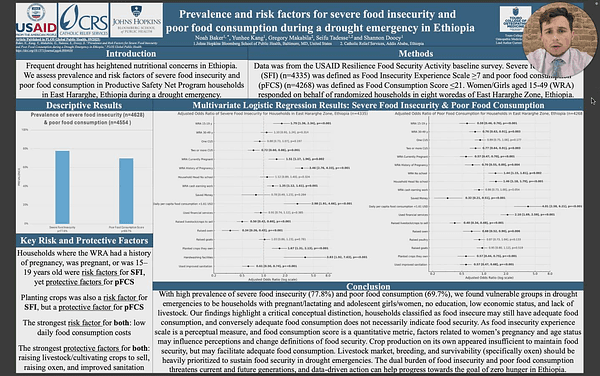
Prevalence and risk factors for severe food insecurity and poor food consumption during a drought emergency in Ethiopia

Prevalence and risk factors for severe food insecurity and poor food consumption during a drought emergency in Ethiopia

2025 AMA Research Challenge – Member Premier Access

Noah Baker

22 October 2025

Stay up to date with the latest Underline news!

Select topic of interest (you can select more than one)

PRESENTATIONS

  • All Presentations
  • For Librarians
  • Resource Center
  • Free Trial
Underline Science, Inc.
1216 Broadway, 2nd Floor, New York, NY 10001, USA

© 2025 Underline - All rights reserved