2025 AMA Research Challenge – Member Premier Access

October 22, 2025

Virtual only, United States

Would you like to see your presentation here, made available to a global audience of researchers?
Add your own presentation or have us affordably record your next conference.

Background

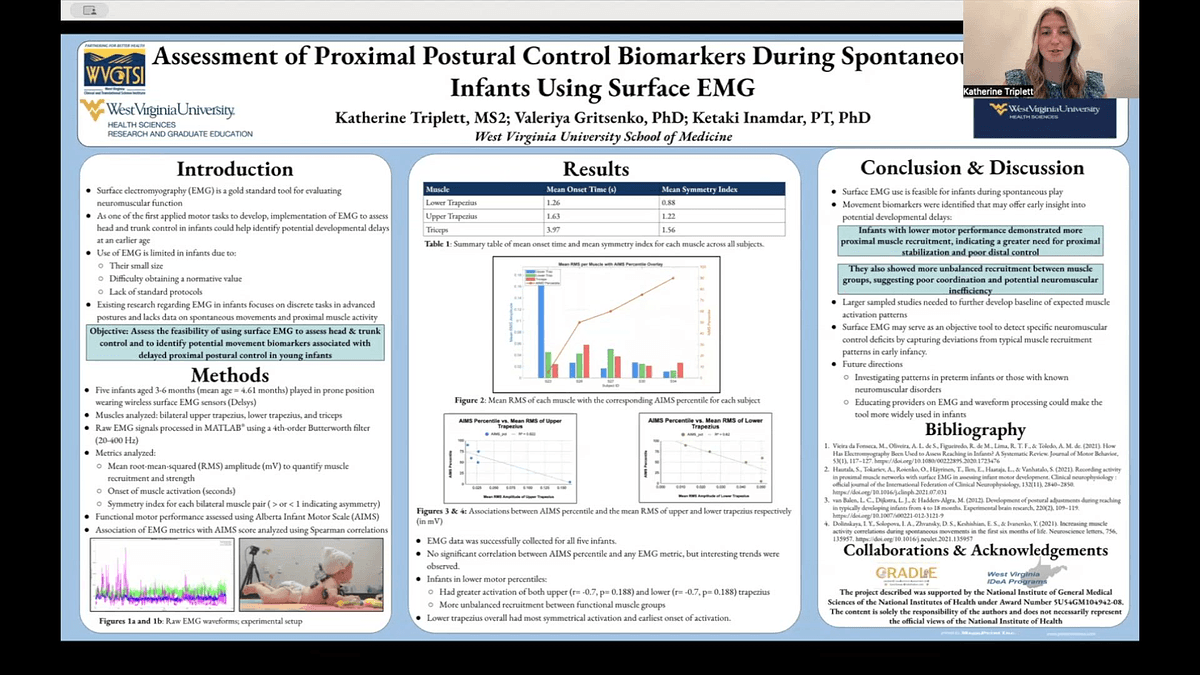
As the first applied motor task to develop, assessment of head and trunk control in infants may provide valuable insight into potential developmental delays. While electromyography (EMG) is the gold standard for assessing neuromuscular function, its use in infants is limited due to their size, difficulty establishing normative values, and lack of standard protocols. Existing research in infants largely focuses on discrete tasks in advanced postures, with few studying spontaneous movements or proximal muscle activity. This study aimed to assess the feasibility of using surface EMG during prone play and to identify potential movement biomarkers associated with delayed postural control in young infants.

Methods

This pilot study involved five infants aged 3-6 months (mean age = 4.61 months). Subjects played in the prone position while wearing wireless surface EMG sensors (Delsys) based on SENIAM guidelines. Bilateral recordings were taken from muscles involved in proximal control: upper trapezius, lower trapezius, and triceps. Functional motor performance was assessed using the Alberta Infant Motor Scale (AIMS) percentiles. Raw EMG signals were processed in MATLAB®. The metrics analyzed were mean RMS amplitudes (mV), bilateral symmetry index ratios (> or < 1 indicating asymmetry), and onset of activation (s). Association between EMG metrics and AIMS percentile was analyzed using Spearman correlations.

Results

EMG data was successfully collected for all five infants. There was no significant correlation between AIMS percentile and EMG metrics collected, but interesting trends were observed. Infants in lower percentiles showed greater upper (r= -0.7) and lower trapezius (r= -0.7) activation and overall unbalanced recruitment between muscle groups compared to infants in higher percentiles. Average muscle onset times across all subjects were: lower trapezius (1.3s), upper trapezius (1.6s), and triceps (3.9s). Symmetry indices varied across participants, with the lower trapezius showing the most consistent symmetry (0.88), compared to upper trapezius (1.22) and triceps (1.56). Lower AIMS percentiles were generally associated with greater asymmetry.

Conclusion

Surface EMG is feasible during prone play. We identified movement biomarkers that may offer early insight into atypical postural control strategies in at-risk infants. Infants with lower motor performance demonstrated more proximal motor unit recruitment, indicating less stability. These infants may be more likely to have asymmetrical recruitment than higher performing infants. Larger sampled studies are needed to further develop the baseline of expected muscle activation patterns. Increased knowledge in this understudied area could aid in identifying potential developmental delays at an earlier age.

Downloads

Transcript English (automatic)

Next from 2025 AMA Research Challenge – Member Premier Access

Development, Implementation and Evaluation of a Novel Neuropalliative Care Education Curriculum

Development, Implementation and Evaluation of a Novel Neuropalliative Care Education Curriculum

2025 AMA Research Challenge – Member Premier Access

Karishma Popli

22 October 2025

Stay up to date with the latest Underline news!

Select topic of interest (you can select more than one)

PRESENTATIONS

  • All Presentations
  • For Librarians
  • Resource Center
  • Free Trial
Underline Science, Inc.
1216 Broadway, 2nd Floor, New York, NY 10001, USA

© 2025 Underline - All rights reserved