2025 AMA Research Challenge – Member Premier Access

October 22, 2025

Virtual only, United States

Would you like to see your presentation here, made available to a global audience of researchers?
Add your own presentation or have us affordably record your next conference.

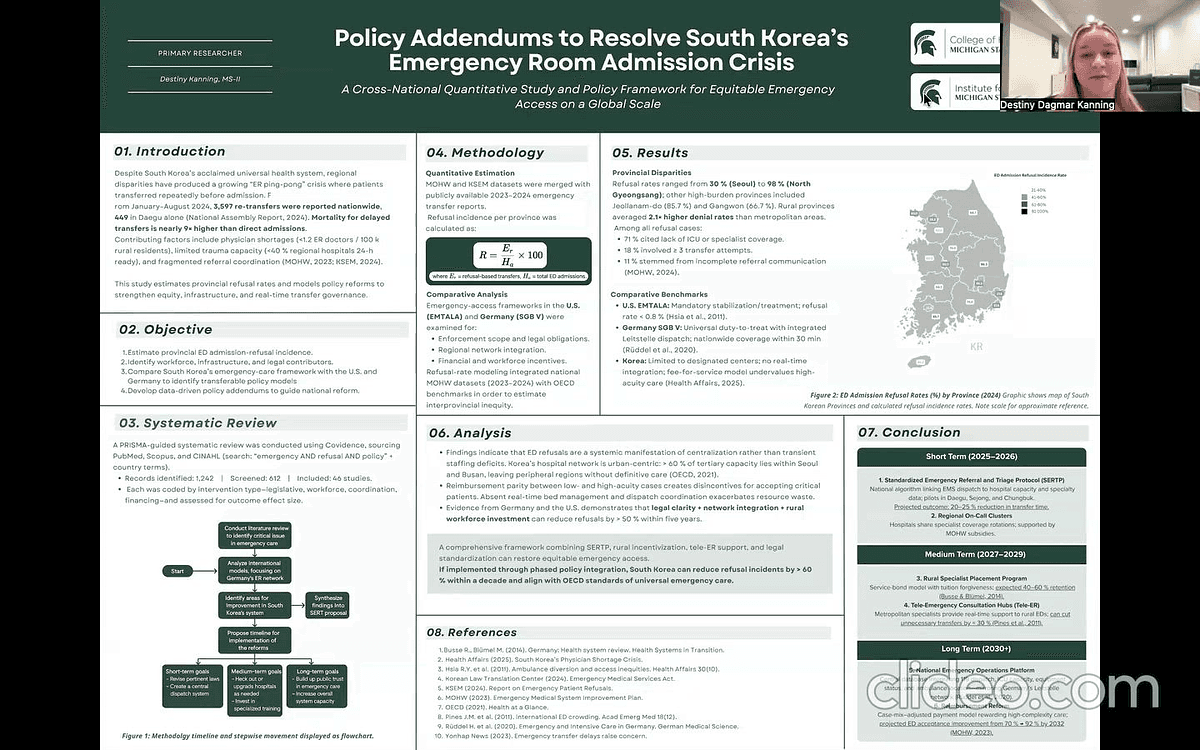
South Korea’s healthcare system is internationally recognized for its accessibility and efficiency; however, beneath this success lies an emergency care crisis marked by widespread hospital refusals of critical patients—a phenomenon known as “ER ping-pong.” Patients, particularly in rural regions, are often transferred between multiple facilities before receiving care, with fatal consequences. Recognizing the absence of national data and clear policy guidance, this study sought to quantify provincial emergency admission refusal rates and evaluate structural reforms to improve equitable access to emergency care.

A PRISMA-guided systematic review was conducted using Covidence to assess 46 peer-reviewed studies on emergency access policies across OECD nations. This was combined with quantitative analysis of South Korea’s 2023–2024 national emergency transfer data, made available through the Ministry of Health and Welfare (MOHW) and the Korean Society of Emergency Medicine (KSEM). Provincial refusal rates were estimated and compared with policy frameworks from the United States (Emergency Medical Treatment and Labor Act, EMTALA) and Germany (Sozialgesetzbuch V and Leitstelle dispatch systems).

Findings reveal that refusal rates range from 30% in Seoul to nearly 98% in North Gyeongsang, with rural provinces experiencing rates more than double those of urban centers. Most refusals cited limited ICU capacity or specialist coverage as primary causes. Comparative analysis demonstrated that regions with integrated referral databases, legal stabilization mandates, and regionalized workforce incentives experience significantly lower refusal rates.

This research proposes a multi-tiered reform model for South Korea, including a Standardized Emergency Referral and Triage Protocol (SERTP), expansion of tele-emergency consultation hubs, and a national integrated emergency operations platform, to reduce refusals by an estimated 60% within a decade. These policy addendums provide an actionable blueprint for improving emergency equity and sustainability within South Korea’s universal health system.

Downloads

Transcript English (automatic)

Next from 2025 AMA Research Challenge – Member Premier Access

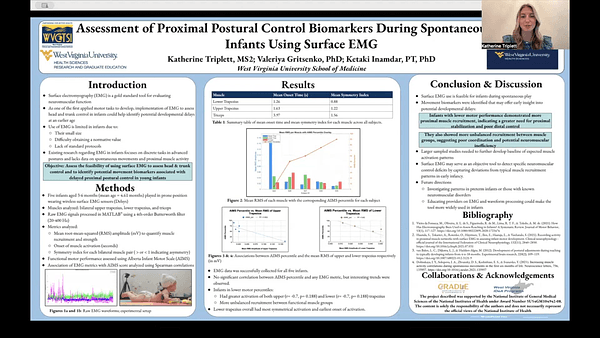
Assessment of Proximal Postural Control Biomarkers During Spontaneous Play in Infants Using Surface EMG

Assessment of Proximal Postural Control Biomarkers During Spontaneous Play in Infants Using Surface EMG

2025 AMA Research Challenge – Member Premier Access

Katherine Triplett
Katherine Triplett

22 October 2025

Stay up to date with the latest Underline news!

Select topic of interest (you can select more than one)

PRESENTATIONS

  • All Presentations
  • For Librarians
  • Resource Center
  • Free Trial
Underline Science, Inc.
1216 Broadway, 2nd Floor, New York, NY 10001, USA

© 2025 Underline - All rights reserved