Would you like to see your presentation here, made available to a global audience of researchers?
Add your own presentation or have us affordably record your next conference.
Background
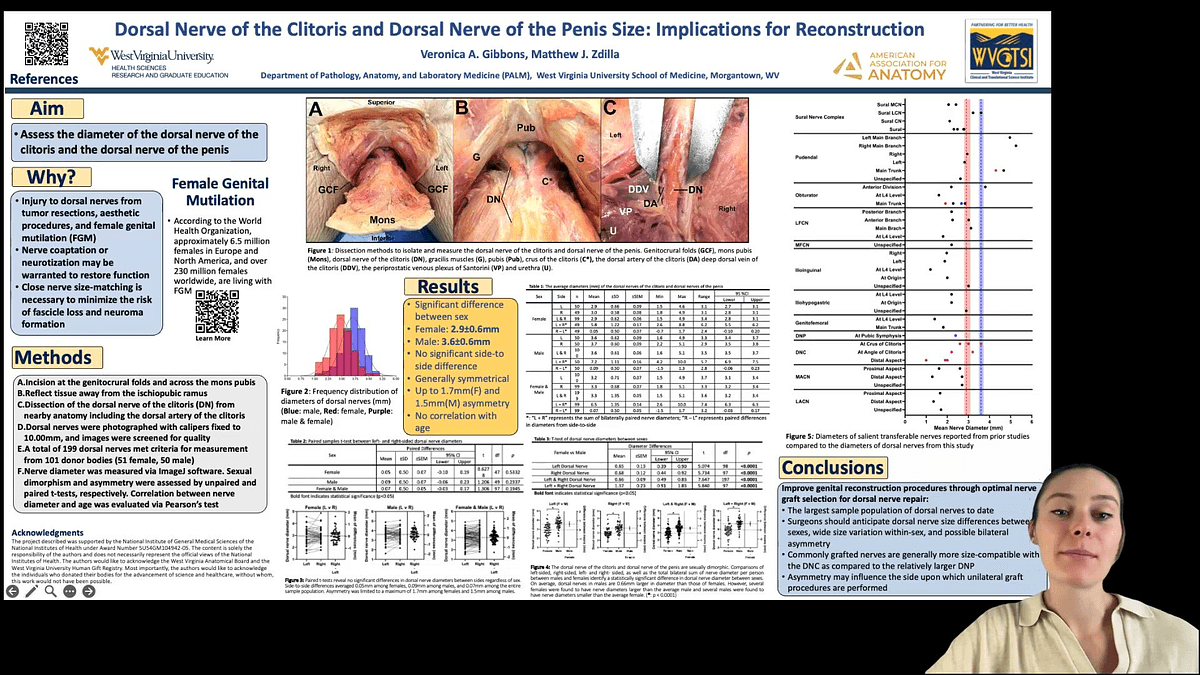
The dorsal nerve of the clitoris (DNC) and dorsal nerve of the penis (DNP) are vital to sexual sensation, erectile function, and reproduction; however, these nerves are frequently subject to injury from tumor resections, aesthetic procedures, and female genital mutilation (FGM). Concerning FGM alone, the World Health Organization notes that approximately 6.5 million females in Europe and North America, and over 230 million females worldwide, are living with FGM. Nerve coaptation or neurotization may be warranted to restore function after dorsal nerve injury. Accordingly, close nerve size-matching is necessary to minimize the risk of fascicle loss and neuroma formation. However, little is known about the diameter of the dorsal nerves. Therefore, this study aims to describe the diameter of the DNC and DNP through gross anatomical assessment.
Methods
A total of 101 donor bodies (51 female, 50 male) were dissected to visualize the paired dorsal nerves as they traveled inferior to the pubic bone. Dorsal nerves were photographed, and images were screened for quality. A total of 199 dorsal nerves met criteria for measurement. Nerve diameter was measured via ImageJ software. Sexual dimorphism and asymmetry were assessed by unpaired and paired t-tests, respectively. Correlation between nerve diameter and age was evaluated via Pearson’s test.
Results
Nerve diameters were normally distributed in both females and males. The DNC diameter averaged 2.9±0.6mm (mean ± SD) (min=1.5mm; max=4.9mm; range=3.4mm) and the DNP averaged 3.6±0.6mm (min=1.6mm; max=5.1mm; range=3.5mm). Significant differences were found between sexes (t=7.647; p<.00001); however, within-sex, no significant side-to-side difference was identified (females: t=0.6278; p=0.5332) (males: t=1.206; p=0.2337). Age was not correlated with nerve size (r=0.17; p=0.248). Although generally symmetrical, bilateral asymmetry of up to 1.7mm in females and 1.5mm in males was noted.
Conclusion
This report details DNC and DNP size from the largest sample population to date. Surgeons should anticipate dorsal nerve size differences between sexes, wide size variation within-sex, and possible bilateral asymmetry. These results, assessed alongside other reports, suggest that commonly grafted nerves are generally more size-compatible with the DNC as compared to the relatively larger DNP. Regarding unilateral graft procedures, such as an ilioinguinal nerve coaptation, asymmetry may influence the side upon which the procedure is performed. The results of this study will improve genital reconstruction procedures and guide optimal nerve graft selection for dorsal nerve repair.