2025 AMA Research Challenge – Member Premier Access

October 22, 2025

Virtual only, United States

Would you like to see your presentation here, made available to a global audience of researchers?
Add your own presentation or have us affordably record your next conference.

Background

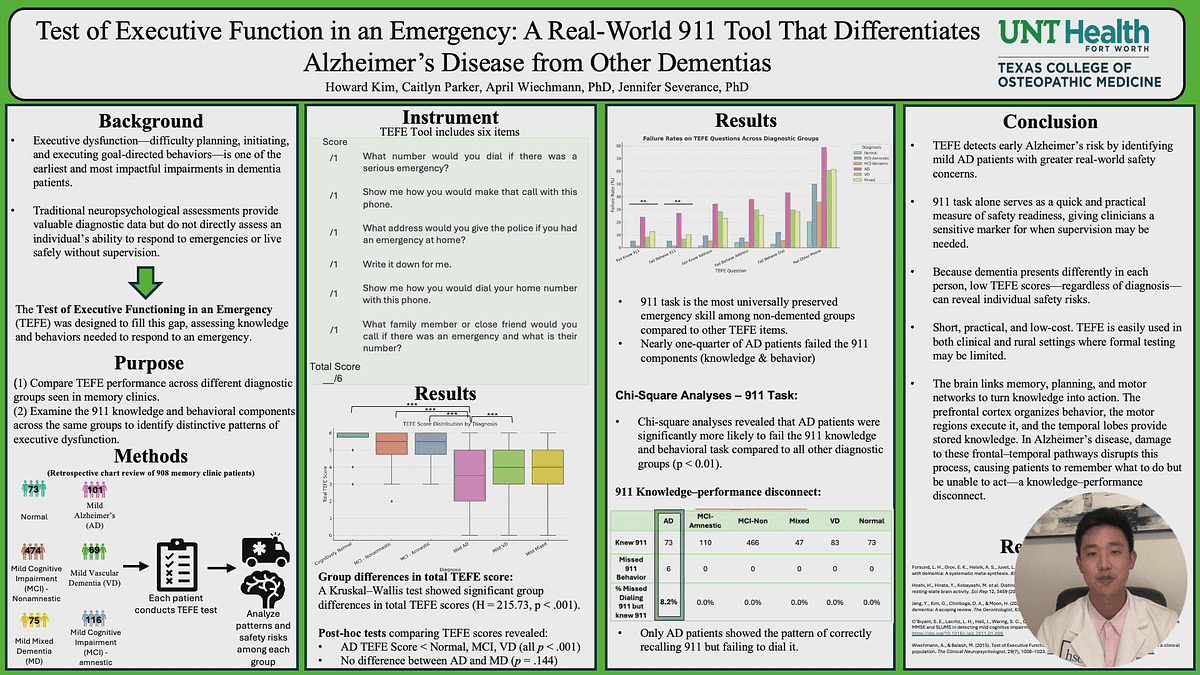
Executive dysfunction in Alzheimer’s disease (AD)—often linked to early frontal lobe involvement—can impair real-world behavior even during the mildest stages, well before memory loss becomes disabling. Yet many clinicians delay supervision planning until patients reach moderate dementia, overlooking critical safety risks in earlier phases. High misdiagnosis rates in early dementia further delay appropriate intervention, especially when subtle but meaningful executive deficits go undetected. Although tools like the Mini-Mental State Examination and Trails B assess cognition, none directly evaluate whether a patient can live safely without supervision. The Test of Executive Functioning in an Emergency (TEFE), developed at UNT Health, addresses this gap. TEFE is a brief, performance-based tool that assesses whether patients can complete real-world safety tasks—such as dialing 911, stating their address, and contacting a family member. This study examined whether TEFE performance—particularly on the 911 task—can differentiate mild AD from vascular dementia (VD), mixed dementia, and mild cognitive impairment (MCI), while also identifying clinically meaningful patterns of executive dysfunction across diagnoses.

Methods

We retrospectively reviewed records of 908 patients from a university-affiliated memory clinic. Diagnoses included mild AD, mild VD, mild mixed dementia, mild cognitive impairment (MCI), or normal cognition. TEFE includes six items total: three knowledge-based questions (e.g., “What number do you call in an emergency?”) and three behavioral tasks (e.g., dialing 911). Total TEFE scores were compared across diagnostic groups using Kruskal-Wallis and chi-square tests. We further analyzed failure rates on the 911 knowledge and behavioral items individually and used contingency tables to examine disconnects between knowing and performing the task (e.g., correctly identifying 911 but failing to dial it).

Results

TEFE performance significantly differed by diagnosis (H = 215.73, p < 1×10−44). AD patients scored significantly lower than MCI or cognitively normal groups. Nearly one-quarter of AD patients failed the 911 knowledge (24.1%) and behavioral (27.0%) tasks. In contrast, 911 failure was rare in non-AD groups—under 6% in MCI and 0% in normal controls. Chi-square tests confirmed AD patients were significantly more likely to fail 911 tasks than VD or mixed dementia (p < 0.001). Only AD patients exhibited a disconnect of identifying 911 but failing to dial it.

Conclusion

TEFE effectively detects executive dysfunction and emergency readiness deficits in mild AD, identifying safety risks not captured by traditional cognitive screens. By revealing real-world impairments before more obvious cognitive decline, TEFE offers actionable insight that help guide earlier interventions in dementia care.

Downloads

Transcript English (automatic)

Next from 2025 AMA Research Challenge – Member Premier Access

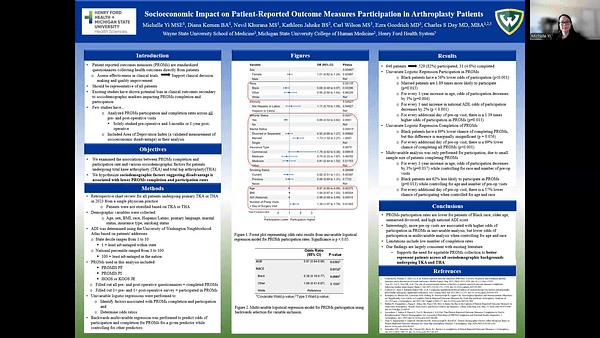
Socioeconomic Impact on Patient-Report Outcome Measures Participation in Arthroplasty Patients

Socioeconomic Impact on Patient-Report Outcome Measures Participation in Arthroplasty Patients

2025 AMA Research Challenge – Member Premier Access

Michelle Yi

22 October 2025

Stay up to date with the latest Underline news!

Select topic of interest (you can select more than one)

PRESENTATIONS

  • All Presentations
  • For Librarians
  • Resource Center
  • Free Trial
Underline Science, Inc.
1216 Broadway, 2nd Floor, New York, NY 10001, USA

© 2025 Underline - All rights reserved