Would you like to see your presentation here, made available to a global audience of researchers?
Add your own presentation or have us affordably record your next conference.
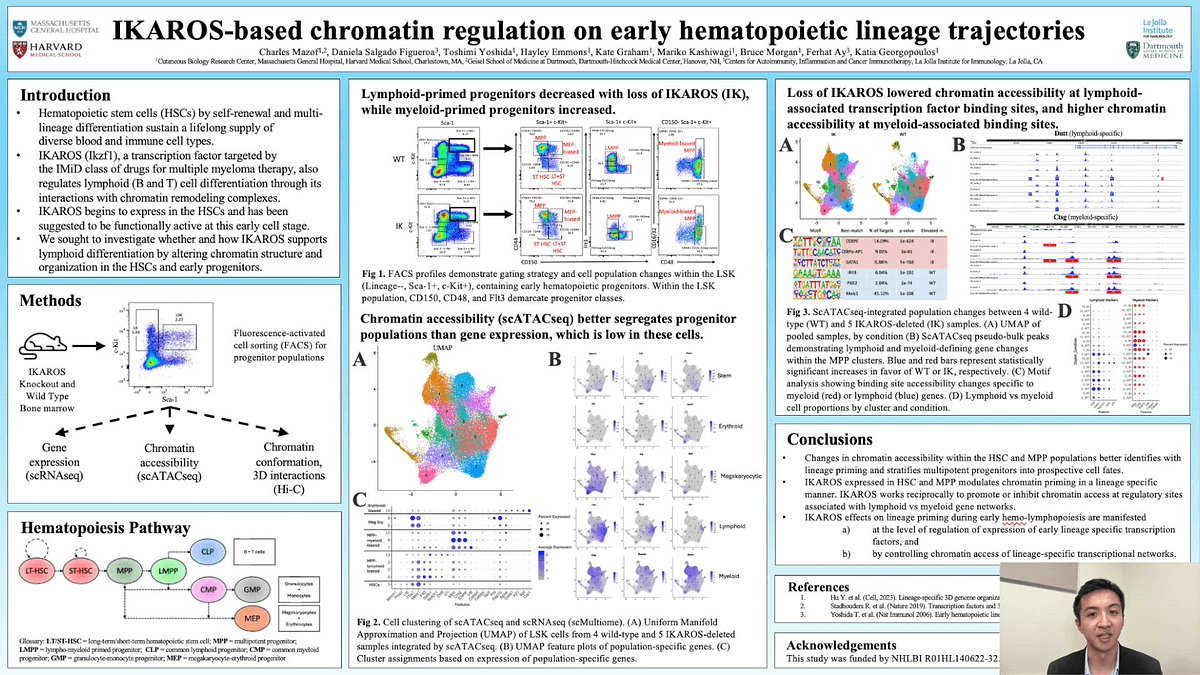
Background Hematopoietic stem cells (HSCs) sustain lifelong blood and immune cell supply through their ability to self-renew and generate diverse cell lineages, beginning with the HSCs and progressing through multipotent progenitors (MPPs) and increasingly lineage-restricted intermediates. These transitions remain incompletely understood, particularly the mechanism involved in lineage priming and the timing within a spectrum of MPPs. IKAROS (Ikzf1), a zinc-finger DNA binding factor, is first expressed in the HSC and increases with lymphoid lineage specification. IKAROS proteins interact with chromatin remodeling complexes during lymphoid lineage differentiation, yet their precise role at the onset of hematopoiesis is not defined. We investigated whether IKAROS alters chromatin structure and organization in the nuclear space and how it influences lineage potentials of the earliest progenitors.
Methods With IKAROS-knockout and wild-type mice, we used fluorescence-activated cell sorting (FACS) to obtain early progenitor subsets from the bone marrow, including the long- and short-term HSCs, MPPs (from LSK: lineage-/loSca1+c-Kit+), and erythro-myeloid restricted precursors (from LK: lineage-/loSca1+c-Kit-). We performed single-cell RNA sequencing (scRNAseq), single-cell Multiome (scRNAseq and scATACseq/Assay for Transposase-Accessible Chromatin), and Hi-C assays to assess gene expression, chromatin accessibility at regulatory sites (e.g. enhancers and promoters), and 3D genome organization, respectively. Novel bioinformatic approaches were developed to integrate transcriptomic and epigenetic data.
Results In IKAROS-deficient LSK populations, lymphoid-primed progenitors (CD150-CD48+Flt3+IL7R+) were markedly reduced, while myeloid-primed subsets (CD150-CD48+CD16/32+) were increased. Meanwhile, heterozygous deletions demonstrated haploinsufficiency with similar but milder effects, providing a working model for IKAROS as a molecular regulator for hemo-lymphopoiesis.
With our scMultiome and scRNAseq datasets, integration of MPPs based solely on scATACseq data yielded clearer cell type segregation than scRNAseq or integrated analyses (scRNAseq and scATACseq), reflecting a greater significance of chromatin accessibility over gene expression at this cell stage. Loss of IKAROS led to decreased accessibility at lymphoid-associated transcription factor binding sites and increased accessibility at myeloid sites, suggesting a shift in lineage potential driven by chromatin-level regulation and potential antagonism with myeloid programs. Ongoing 3C (Hi-C) studies examine the influence of IKAROS on lineage-specific 3D organization that appears to precede lineage restrictions.
Conclusion Our study shows that IKAROS, a key regulator of early hemo-lymphopoiesis, is required for chromatin access at lineage-specific regulatory sites and three-dimensional genome organization. These findings highlight the importance of epigenetic mechanisms in governing early blood cell fates and suggest a new model of blood cell differentiation through lineage-specific epigenetic programs operating prior to lineage specification.