2025 AMA Research Challenge – Member Premier Access

October 22, 2025

Virtual only, United States

Would you like to see your presentation here, made available to a global audience of researchers?
Add your own presentation or have us affordably record your next conference.

Background

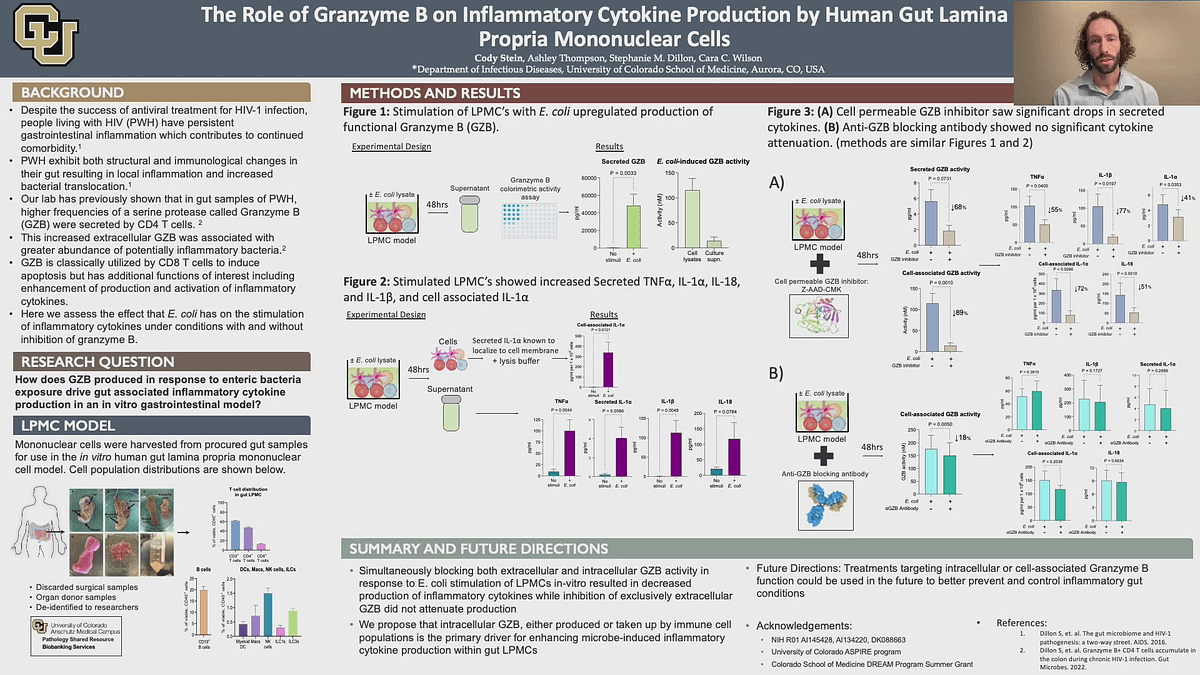
Despite the success of antiviral treatment for HIV-1 infection, people living with HIV (PWH) have persistent gastrointestinal inflammation which contributes to continued comorbidity. HIV-1 associated gut pathogenesis includes both structural and immunological changes resulting in local inflammation and increased bacterial translocation. In our prior study we observed that in PWH, higher frequencies of a serine protease called Granzyme B (GZB) were associated with greater abundance of potentially inflammatory bacteria. Moreover, enteric bacteria were shown to induce higher frequencies of GZB expressing gut CD4+ T cells. GZB is classically utilized by cytotoxic T cells to induce apoptosis but has additional functions of interest including inflammatory cytokine activation. Currently, significant gaps remain in how GZB affects inflammatory cytokine profiles in the gut. Here we aim to assess how GZB produced in response to enteric bacteria exposure drives gut associated inflammatory cytokine production in a gastrointestinal in vitro model.

Methods

We utilized our previously established human gut lamina propria mononuclear cell (LPMCs) in-vitro model. LPMCs were stimulated with commensal Escherichia coli (E. coli) lysate in the presence of a cell permeable GZB inhibitor or extracellular anti-GZB blocking antibody. Levels of TNFα, IL-1α, IL-18, and IL-1β, which have been previously shown to be produced in response to exposure to granzymes, were measured by ELISA. Measurement after 48 hours was determined to be the optimal observation time.

Results

Exposure of LPMC’s to E. coli for 48 hours induced significantly higher levels of secreted GZB with measurable activity compared to LPMCs that were not exposed to E. coli. Secreted TNFα, IL-1α, IL-18, and IL-1β, and cell associated IL-1α were also increased. In the presence of cell permeable GZB inhibitor, intracellular and extracellular GZB activity was significantly inhibited, and cytokine production decreased to levels similar to unstimulated conditions. In the presence of extracellular anti-GZB blocking antibody, only extracellular GZB activity was significantly inhibited, however E. coli stimulated cytokine production was not reduced.

Conclusion

Simultaneously blocking of both extracellular and intracellular GZB activity in response to E. coli stimulation of LPMCs in-vitro resulted in decreased production of inflammatory cytokines while inhibition of exclusively extracellular GZB did not attenuate production. This suggests that intracellular GZB, either produced or taken up by immune cell populations is the primary driver for enhancing microbe-induced inflammatory cytokine production within gut LPMCs. Treatments targeting intracellular Granzyme B function could be used in the future to better prevent and control inflammatory gut conditions.

Downloads

Transcript English (automatic)

Next from 2025 AMA Research Challenge – Member Premier Access

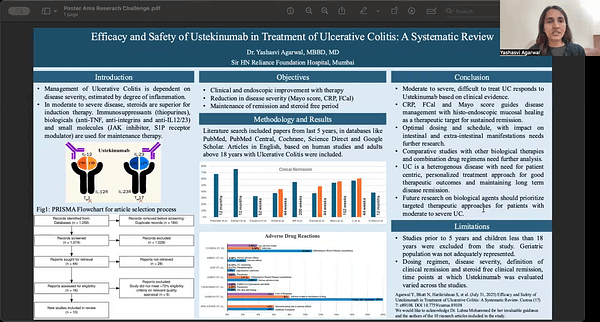
Efficacy and Safety of Ustekinumab in Treatment of Ulcerative Colitis: A Systematic Review

Efficacy and Safety of Ustekinumab in Treatment of Ulcerative Colitis: A Systematic Review

2025 AMA Research Challenge – Member Premier Access

Yashasvi Agarwal
Yashasvi Agarwal

22 October 2025

Stay up to date with the latest Underline news!

Select topic of interest (you can select more than one)

PRESENTATIONS

  • All Presentations
  • For Librarians
  • Resource Center
  • Free Trial
Underline Science, Inc.
1216 Broadway, 2nd Floor, New York, NY 10001, USA

© 2025 Underline - All rights reserved