2025 AMA Research Challenge – Member Premier Access

October 22, 2025

Virtual only, United States

Would you like to see your presentation here, made available to a global audience of researchers?
Add your own presentation or have us affordably record your next conference.

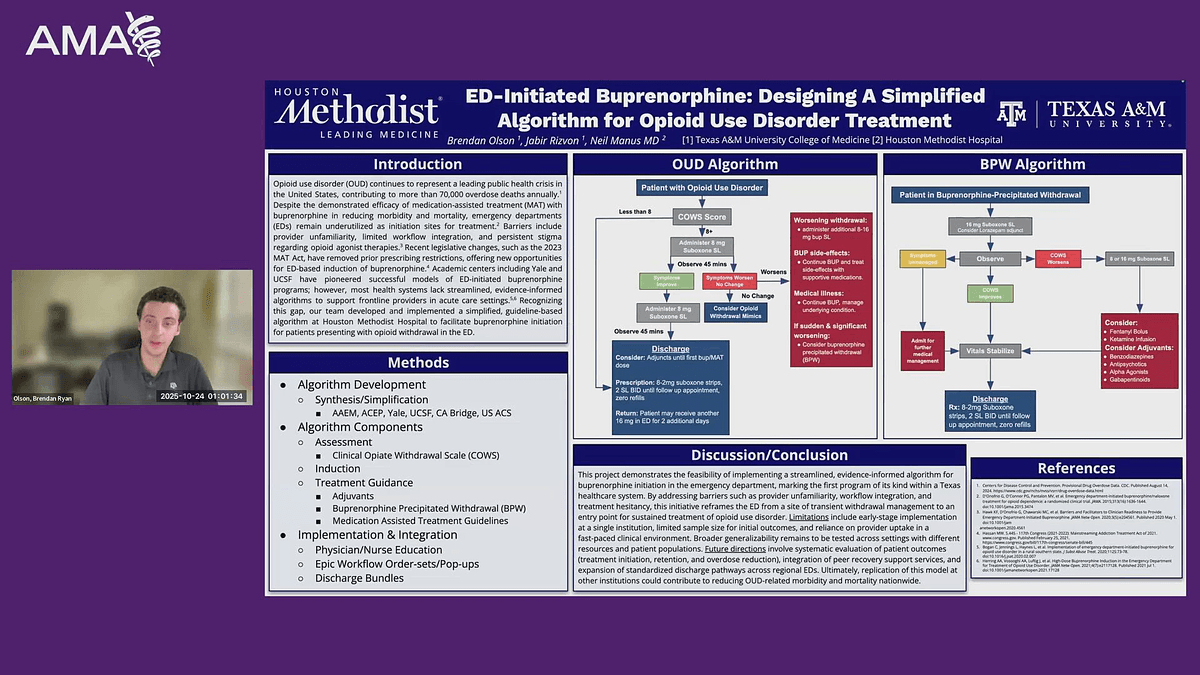
Background Opioid use disorder (OUD) continues to drive significant morbidity and mortality across the U.S., yet emergency departments (EDs) remain underutilized as initiation points for evidence-based medication-assisted treatment (MAT). Despite legislation such as the 2023 MAT Act removing prior prescribing restrictions for buprenorphine, most ED physicians remain unfamiliar and reluctant to treat patients experiencing opioid withdrawal with partial opioid agonists such as buprenorphine. Academic centers such as Yale and UCSF have successfully piloted and implemented ED-based buprenorphine programs, but many hospital systems lack comprehensive systems to treat OUD in patients effectively in the fast-paced ED setting. Recognizing this gap, we developed and initiated a streamlined, evidence-informed algorithm for buprenorphine initiation in ED patients presenting with opioid withdrawal at Houston Methodist Hospital in Texas.

Methods Our team synthesized peer-reviewed protocols and national guidelines from AAEM, ACEP, and published institutional frameworks to construct a simplified algorithm tailored for frontline ED use. The algorithm incorporated patient assessment via the Clinical Opiate Withdrawal Scale (COWS) and guided physicians through staged buprenorphine-naloxone induction steps based on symptom severity. Adjuvant therapy choices were included as algorithm side branches for patients experiencing buprenorphine-induced withdrawal. Recognizing physician hesitancy and knowledge gaps, the algorithm was designed for ease-of-use. Supplemental material for successful adoption by ED physicians incorporated research-driven treatment statistics, education on partial opioid agonists pharmacologic principles, and contraindications for treatment. In collaboration with institution staff, the tool was integrated into ED workflows, paired with a standardized discharge bundle including a curated list of outpatient MAT resources.

Results A simplified algorithm was implemented into the emergency department and electronic medical record. Data collection from outcomes of the implementation is ongoing across the Houston Methodist system. Formal tracking of MAT initiation rates and longitudinal patient outcomes are planned. Study design includes evaluation of implementation fidelity, patient engagement at follow-up, and trends in ED recidivism. Patient-facing resources are being distributed at the point of discharge for OUD patients started on buprenorphine, improving continuity of care and outpatient follow-up.

Conclusion This project demonstrates the feasibility of deploying a simplified ED-based buprenorphine algorithm within a large healthcare system, the first of its kind in Texas. By addressing key barriers to MAT initiation, this approach has the potential to shift emergency departments from treating transient opioid withdrawal toward long-term treatment engagement for patients suffering from OUD. Future evaluation will assess clinical impact and generalizability, with the goal of encouraging replication at other hospitals and institutions nationwide.

Downloads

Transcript English (automatic)

Next from 2025 AMA Research Challenge – Member Premier Access

Recurrent Hypoglycemia and Dementia Risk in Older Adults with Type 2 Diabetes: A Systematic Review

Recurrent Hypoglycemia and Dementia Risk in Older Adults with Type 2 Diabetes: A Systematic Review

2025 AMA Research Challenge – Member Premier Access

Dena Kamel

22 October 2025

Stay up to date with the latest Underline news!

Select topic of interest (you can select more than one)

PRESENTATIONS

  • All Presentations
  • For Librarians
  • Resource Center
  • Free Trial
Underline Science, Inc.
1216 Broadway, 2nd Floor, New York, NY 10001, USA

© 2025 Underline - All rights reserved