2025 AMA Research Challenge – Member Premier Access

October 22, 2025

Virtual only, United States

Would you like to see your presentation here, made available to a global audience of researchers?
Add your own presentation or have us affordably record your next conference.

Abstract Title

Use of Hypercalcemia and Vitamin D Levels in the Diagnosis of Sarcoidosis

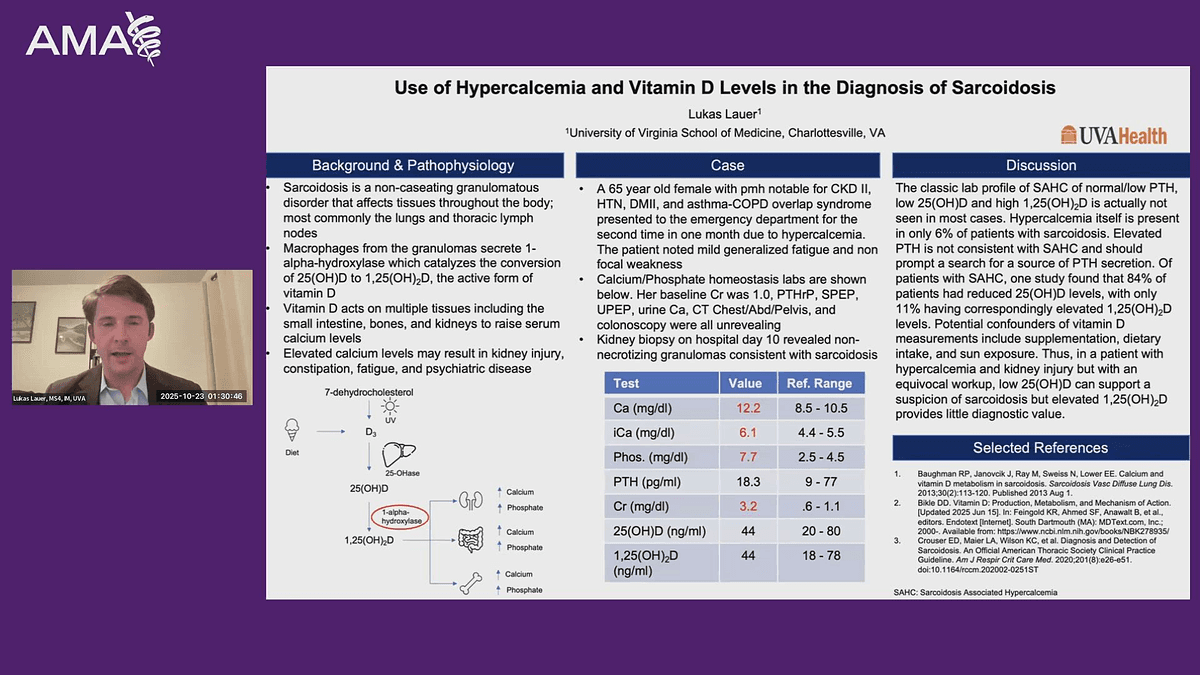
Background Sarcoidosis is a granulomatous disorder that most often affects the respiratory system, but can involve tissues throughout the body. The disease may cause hypercalcemia (termed sarcoidosis associated hypercalcemia (SAHC)) as macrophages within the granulomas secrete 1α-hydroxylase resulting in conversion of 25(OH)D to 1,25(OH)2D. Renal injury can be seen in sarcoidosis secondary to hypercalcemia or as a direct result of granuloma formation in the kidneys.

Case Presentation A 65 year old female with past medical history notable for CKD II, HTN, DMII, and asthma-COPD overlap syndrome presented to the emergency department for the second time in one month due to hypercalcemia. The patient noted mild generalized fatigue and non focal weakness. Her medications included metformin, semaglutide, and a multivitamin. Laboratory evaluation revealed Ca of 12.2, ionized Ca of 6.1, phosphorus of 7.7, PTH of 18.3, and Cr of 3.2 from a baseline of 1.0 (GFR = 56). PTHrP from her prior hospitalization earlier in month revealed 25(OH)D wnl, 1,25(OH)2D wnl, kappa/lambda ratio mildly elevated, SPEP wnl, UPEP wnl, and urine Ca wnl. Workup of humoral hypercalcemia of malignancy included CT chest, abdomen, and pelvis, and colonoscopy which were all non-revealing. On hospital day 10 a kidney biopsy was performed and eventually revealed non-necrotizing granulomas consistent with sarcoidosis. The patient was started on prednisone with slow normalization of calcium and creatine levels.

Discussion The classic lab profile of SAHC of normal/low PTH, low 25(OH)D and high 1,25(OH)2D is actually not seen in most cases. Hypercalcemia itself is present in only 6% of patients with sarcoidosis. Elevated PTH is not consistent with SAHC and should prompt a search for a source of PTH secretion. Of patients with SAHC, one study found that 84% of patients had reduced 25(OH)D levels, with only 11% having correspondingly elevated 1,25(OH)2D levels. Potential confounders of vitamin D measurements include supplementation, dietary intake, and sun exposure. Of note, our patient previously discontinued vitamin D supplementation, but was still taking a multivitamin which contained vitamin D. Thus, in a patient with hypercalcemia and kidney injury but with an equivocal workup, low 25(OH)D can support a diagnosis of sarcoidosis, but elevated 1,25(OH)2D provides little diagnostic value. However, 25(OH)D has several confounders, and this case illustrates that it is neither completely sensitive nor specific, and biopsy is still necessary to establish a diagnosis.

Downloads

Transcript English (automatic)

Next from 2025 AMA Research Challenge – Member Premier Access

Exploring Muir-Torre Syndrome: A rare case study of Eyelid Sebaceous Adenoma in a Lynch syndrome patient

Exploring Muir-Torre Syndrome: A rare case study of Eyelid Sebaceous Adenoma in a Lynch syndrome patient

2025 AMA Research Challenge – Member Premier Access

Ajaybir Singh Buttar

22 October 2025

Stay up to date with the latest Underline news!

Select topic of interest (you can select more than one)

PRESENTATIONS

  • All Presentations
  • For Librarians
  • Resource Center
  • Free Trial
Underline Science, Inc.
1216 Broadway, 2nd Floor, New York, NY 10001, USA

© 2025 Underline - All rights reserved