Would you like to see your presentation here, made available to a global audience of researchers?
Add your own presentation or have us affordably record your next conference.
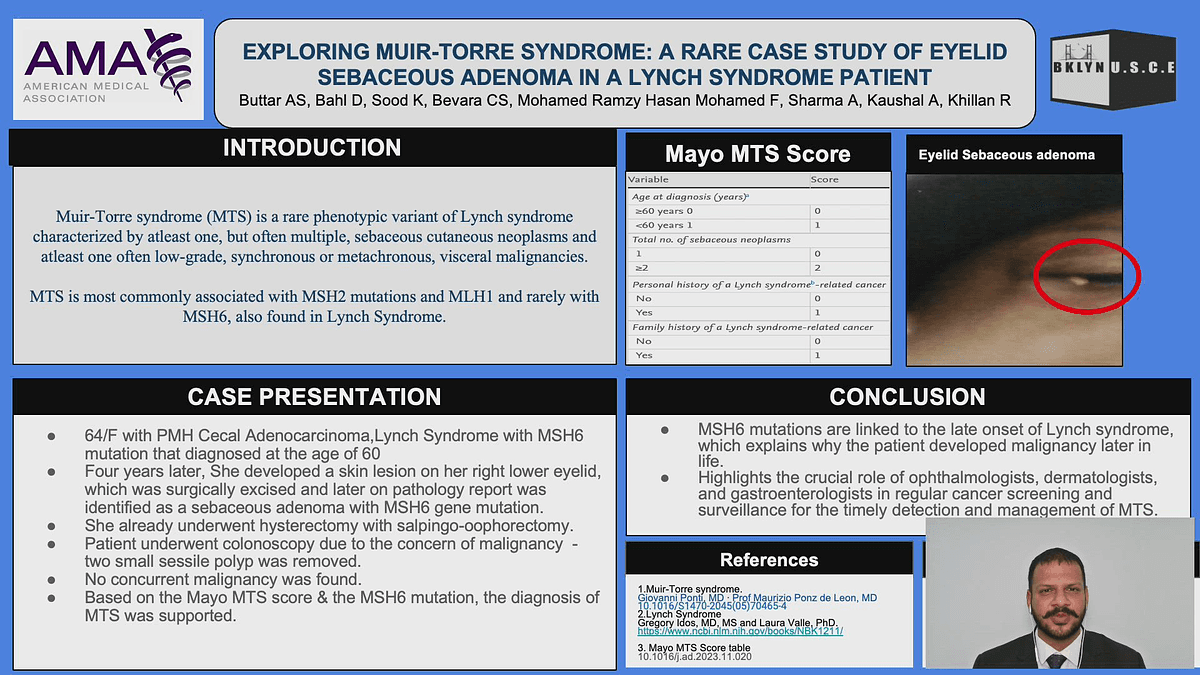
Introduction: Muir-Torre syndrome (MTS) is a rare phenotypic variant of Lynch syndrome with approximately 200 reported cases occurring in both sexes, having a male-to-female ratio of 3:2. It is characterized by both visceral malignancies (colorectal and endometrial tumors) and dermatological neoplasms (sebaceous adenoma, sebaceous adenocarcinoma, keratocanthomas and basal cell carcinoma with sebaceous differentiation). Sebaceous adenomas are the most common dermatological manifestations on the head and neck, particularly the periocular area. In MTS, 56% of skin lesions occur after diagnosing visceral malignancy, 6% co-occur, and 22% occur before a visceral malignancy diagnosis. MTS is most commonly associated with MSH2 mutations and rarely with MLH1 and MSH6, also found in Lynch Syndrome. Case Description: This is the case of a 64-year-old female patient with a medical history of cecal adenocarcinoma. At the age of 60, she underwent a screening colonoscopy, which revealed a large polypoid carpeted mass. The mass was surgically removed through hemicolectomy, and the pathology reported 3.1cm intramucosal well-differentiated stage 0 adenocarcinoma. Due to a family history of endometrial carcinoma in her mother, breast cancer in her sister, and colon cancer in her cousin, subsequent genetic testing was recommended, revealing an MSH6 mutation, confirming the diagnosis of Lynch syndrome. The patient also underwent a prophylactic hysterectomy with B/L salpingo-oophorectomy. Four years later, the patient developed a lesion on her right lower eyelid, which was surgically excised and later identified as a sebaceous adenoma with MSH6 gene mutation, indicating Muir-Torre syndrome (MTS). Based on the Mayo MTS score & the MSH6 mutation, the diagnosis of MTS was supported. Later, the patient underwent a colonoscopy to rule out colon cancer, which revealed two small sessile polyps, each measuring 2 mm, in the mid-sigmoid colon. Conclusion: This case emphasizes the importance of early identification of patients with Muir-Torre syndrome (MTS), as they are at a higher risk for developing multiple primary malignancies, including GI, gynecological, and dermatological tumors. MSH6 mutations are linked to the late onset of Lynch syndrome, which explains why the patient developed malignancy later in life. It highlights the crucial role of ophthalmologists, dermatologists, and gastroenterologists in regular cancer screening and surveillance for the timely detection and management of MTS.