Premium content
Access to this content requires a subscription. You must be a premium user to view this content.

Would you like to see your presentation here, made available to a global audience of researchers?
Add your own presentation or have us affordably record your next conference.
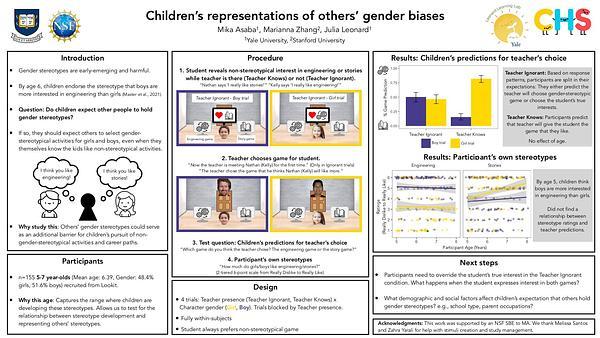
Gender stereotypes are early-emerging and harmful for young children. However, it is unclear if and when children expect other people to hold gender stereotypes, especially if children themselves hold different beliefs. Across two preregistered experiments (total n=275), we measured 5- to 7-year-olds’ predictions for which activity (an engineering game or story game) a teacher would give to a boy or girl student. Critically, in our study, participants always knew the students’ true interests, while teachers sometimes knew and sometimes did not. Experiment 1 showed that 5- to 7-year-olds are sensitive to whether the teacher knows or is ignorant about the students’ interests. Critically, in Experiment 2, we found that 6- and7-year-olds predicted that teachers would give students stereotypical games (e.g., engineering game for boys, and the story game for girls), even though participants knew that the students would be happy with either game. Thus, by the time children enter school, they think that adults hold gender stereotypes even if they themselves do not, which could have negative consequences for children’s learning.
Authors:
Mika Asaba: Yale University; Marianna Y. Zhang: Stanford University; Julia Anne Leonard: Yale University