Premium content
Access to this content requires a subscription. You must be a premium user to view this content.

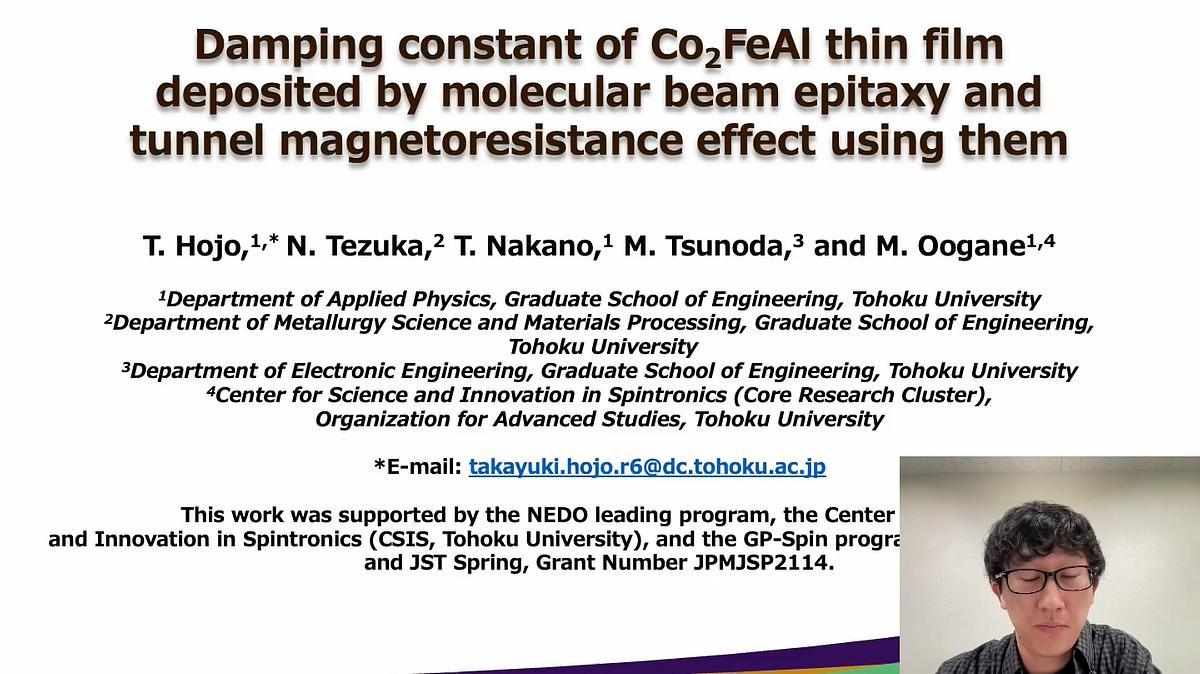
Magnetic Tunnel junctions (MTJs) with Co2FeAl Heusler alloy electrode are expected to show giant TMR ratio at room temperature (RT) because of its half-metallicity. In previous work, although Co2FeAl/MgO/CoFe-MTJ showed a TMR ratio of 330% at RT 1, it is still smaller than those for MTJs with CoFeB electrodes. In order to realize a large TMR ratio at RT, it is necessary to fabricate high-quality Heusler alloy electrodes and to control the interface at the atomic level. Therefore, I focused on molecular beam epitaxy (MBE) technique, which enables the fabrication of highly ordered Heusler alloy thin films 2 and atomic level interfacial modification 3. In this work, we prepared epitaxial Co2FeAl thin films by MBE technique and characterized their magnetic properties to identify the half-metallicity of the Co2FeAl films. In addition, TMR effect in Co2FeAl/MgO/CoFe-MTJs fabricated by MBE were investigated.
The films were deposited on MgO(001) substrate using MBE and sputtering methods. The stacking structure of the Co2FeAl films were Cr(20)/Co2FeAl(50)/MgO(5) (unit of nm). After the fabrication of Co2FeAl layers, the films were annealed at Ta=200~700°C. Structural and magnetic properties were measured by XRD, VSM and FMR. The stacking structure of MTJs was Cr(20)/Co2FeAl(30)/MgO(2.0)/CoFe(5)/IrMn(10)/Cr(5) (unit of nm). After the microfabrication, the MTJ devices were annealed at TMTJ=275~425°C under 1T magnetic fields. TMR effects were measured by DC 4-probe method.
The Co2FeAl film with Ta=600°C showed high B2 order parameter and high magnetization. In addition, as shown in Fig.1, it showed very small damping constant α of 1.8×10⁻³, indicating that the film has good half-metallicity. Fig.2 shows the magnetoresistance curves of the MTJs measured at RT. A relatively large TMR ratio of 125% at TMTJ=400°C was observed and the TMR ratio can be improved by insertion of ultrathin Mg or Al into the Co2FeAl/MgO interface due to suppression of the interfacial state and oxidation.
This work was supported by NEDO, JSPS, GP-Spin Program and JST SPRING, Grant Number JPMJS2114.
References 1 W. Wang, H. Sukegawa and K. Inomata, Appl. Phys. Lett. 95, 182502 (2009)
2 M. Oogane, A. P. McFadden and C. J. Palmstrøm, Appl. Phys. Lett. 112, 262407 (2018)
3 K. Himi, K. Takahashi and S. Mitani, Appl. Phys. Lett. 78, 1436 (2001)