Premium content
Access to this content requires a subscription. You must be a premium user to view this content.

Would you like to see your presentation here, made available to a global audience of researchers?
Add your own presentation or have us affordably record your next conference.
keywords:
cross-lingual parsing
amr parsing
semantic parsing
parsing
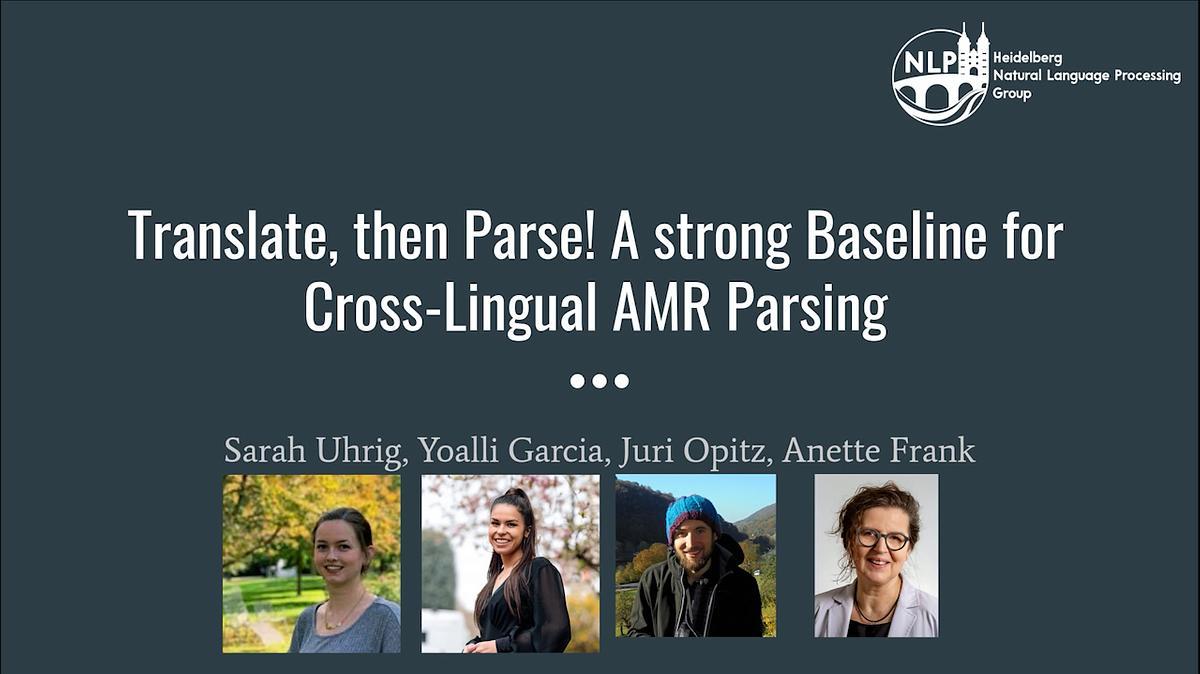
In cross-lingual Abstract Meaning Representation (AMR) parsing, researchers develop models that project sentences from various languages onto their AMRs to capture their essential semantic structures: given a sentence in any language, we aim to capture its core semantic content through concepts connected by manifold types of semantic relations. Methods typically leverage large silver training data to learn a single model that is able to project non-English sentences to AMRs. However, we find that a simple baseline tends to be over-looked: translating the sentences to English and projecting their AMR with a monolingual AMR parser (translate+parse,T+P). In this paper, we revisit this simple two-step base-line, and enhance it with a strong NMT system and a strong AMR parser. Our experiments show that T+P outperforms a recent state-of-the-art system across all tested languages: German, Italian, Spanish and Mandarin with +14.6, +12.6, +14.3 and +16.0 Smatch points.