FROMANNUAL REVIEWS

CogSci 2026

•

•

Rio de Janeiro, Brazil

Non-contingent learning data can lead to the (seemingly) illusory perception of causality if the potential cause and effect often co-occur -- an effect known as "outcome-density bias." Bayesian models of causal induction explain this effect as the result of a rational learning process in which the data do not fully override non-zero causal priors. Convincing evidence for this rational explanation requires the demonstration of an experimentally manipulated effect of causal priors, which has been lacking. We successfully manipulated participants' N = 300 causal priors through visually conveyed causal mechanism information. This manipulation influenced the outcome-density effect in the predicted way: in a condition inducing low causal priors, the effect disappeared. The results demonstrate the effectiveness of visual mechanism information in manipulating priors and strengthen the Bayesian view of causal induction.
Next from CogSci 2026

Evidential Dependence and Polarization in Social Networks

Evidential Dependence and Polarization in Social Networks

CogSci 2026

Ulrike Hahn
David Young
Leon Assaad and 2 other authors

Similar lecture

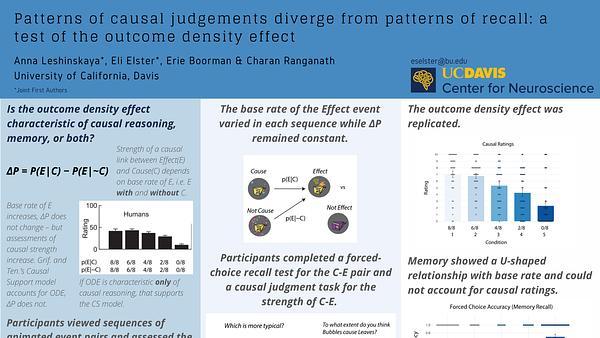
Patterns of Causal Judgements Diverge from Patterns of Recall: a Test of the Outcome Density Effect
poster

Patterns of Causal Judgements Diverge from Patterns of Recall: a Test of the Outcome Density Effect

CogSci 2022

Anna Leshinskaya

28 July 2022

Stay up to date with the latest Underline news!

Select topic of interest (you can select more than one)

PRESENTATIONS

  • All Presentations
  • For Librarians
  • Resource Center
  • Free Trial
Underline Science, Inc.
1216 Broadway, 2nd Floor, New York, NY 10001, USA

© 2026 Underline - All rights reserved

This site is protected by reCAPTCHA and the Google Privacy Policy and Terms of Service apply.