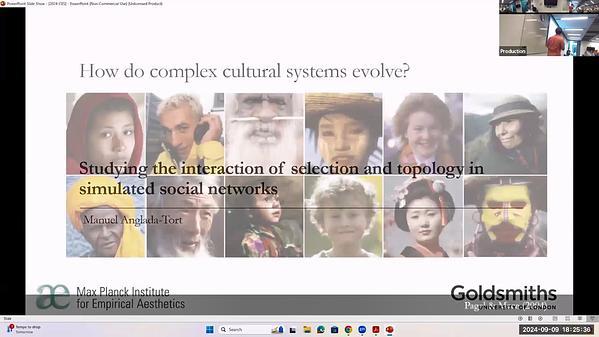
Cultural artifacts such as language rarely evolve in isolation. Rather, they are the product of the inductive biases of learners and the social learning strategies they deploy within their environment. Formal accounts of this process using Bayesian agents often emphasize the role of inductive biases (priors) in controlling the stationary distribution of artifacts, with no effect of social structure (topology) under random social learning (i.e., choosing a random person to learn from). Here, we explore how nonlinear social learning strategies modify this picture by studying the interaction of two social learning mechanisms (conformity and utility biases) with network topology in models of language evolution. Using perturbative expansions around the random baseline, we show that nonlinear learning strategies can couple local network correlations with global population statistics. This coupling leads to deviations from the prior and allows topology to influence the stationary distribution of languages, which we confirm in a simulation.