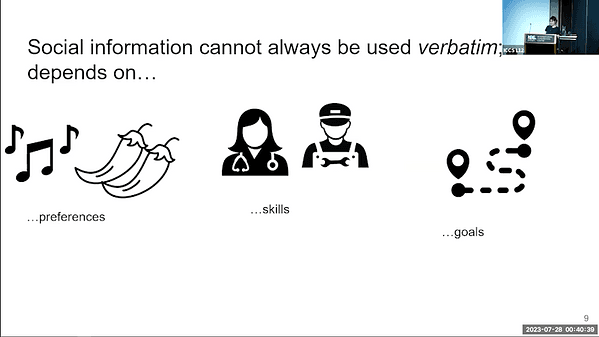
Computational models of social learning often assume learners and demonstrators share identical or at least positively correlated goals. Yet this assumption limits applications to real-world scenarios, where preferences may be misaligned or even opposed. We address this gap by extending the socially correlated bandit task to settings where agents need to learn when social information is positively correlated, uncorrelated, or negatively correlated, analogous to learning whom to trust or distrust. We introduce Social Correlation–Adjusted LEarning (SCALE), a multi-output Gaussian Process model that learns the covariance structure between agents' preferences. Using simulations, we characterize the model's performance across social environments and outline a path toward agents that can dynamically infer social correlations from experience. Our model allows us to reframe prior experimental observations, and lays the groundwork for future experimental work on the integration of preferences into individual decision-making.