FROMANNUAL REVIEWS

CogSci 2026

•

•

Rio de Janeiro, Brazil

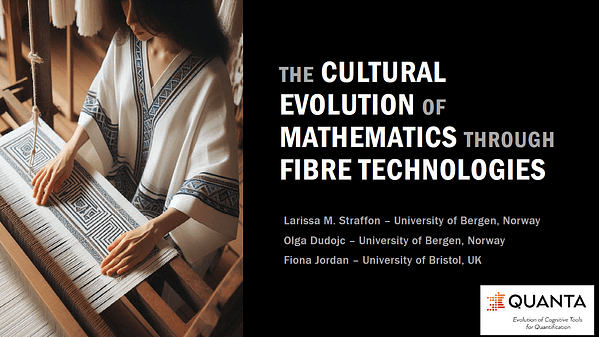
Mathematical cognition is often studied through formal systems or experimental tasks, leaving open how abstract numerical concepts emerge from everyday practices. This paper reviews ethnographic and ethnomathematical studies of weaving crafts, arguing that these practices minimally and systematically recruit a set of cognitive capacities that are central to quantification: grouping, ordering, pairing, memory, exhaustion detection, and cardinality. Across cultures and technologies, weaving stabilizes these capacities through material constraints, procedural regularity, and visual structure, affording the emergence of geometric and numerical knowledge. Therefore, weaving is put forward as a model system for studying the embodied and culturally scaffolded origins of mathematical abstraction, with implications for theories of numerical cognition and material engagement.

Next from CogSci 2026

From Neural Control to Cognitive Explanation: Closedoop Negative Feedback and Marr’s Levels in YINBEHA

From Neural Control to Cognitive Explanation: Closedoop Negative Feedback and Marr’s Levels in YINBEHA

CogSci 2026

Jyrki Suomala
Suvi Sivén and 1 other author

Similar lecture

LIVE - The cultural evolution of mathematics through fibre technologies
technical paper

LIVE - The cultural evolution of mathematics through fibre technologies

Cultural Evolution Society Conference 2024

Larissa Straffon
Olga Dudojc
Fiona Jordan
Larissa Straffon and 2 other authors

11 September 2024

Stay up to date with the latest Underline news!

Select topic of interest (you can select more than one)

PRESENTATIONS

  • All Presentations
  • For Librarians
  • Resource Center
  • Free Trial
Underline Science, Inc.
1216 Broadway, 2nd Floor, New York, NY 10001, USA

© 2026 Underline - All rights reserved

This site is protected by reCAPTCHA and the Google Privacy Policy and Terms of Service apply.