FROMANNUAL REVIEWS

CogSci 2026

•

•

Rio de Janeiro, Brazil

In group rhythmic behavior, the tempo increase phenomenon can emerge even when participants appear well synchronized. We analyzed collective clapping from 49 participants while manipulating modality (auditory/visual/audiovisual) and group size (pair/trio). We tested a sequential effect in which beat-wise asynchrony A(k) predicts the subsequent tempo change μ(k). For each trial, we estimated accel and plateau phases by fitting a one-breakpoint piecewise linear regression to the smoothed tempo series and selecting the breakpoint kp via an AIC-based grid search, using only the tempo series to avoid circular inference. In the confirmatory analysis w=7, an AR(1) mixed-effects model revealed a robust sequential effect: larger asynchrony predicted a more negative immediate tempo change (shorter subsequent ICI). The coupling was stronger during accel and attenuated toward zero during plateau, and it was strongest in the visual condition during accel. An exploratory check across w=1...15 yielded consistent patterns.

Next from CogSci 2026

Modality-specific dynamics and context dependent involvement of visuospatial and verbal abilities in analogical mapping

Modality-specific dynamics and context dependent involvement of visuospatial and verbal abilities in analogical mapping

CogSci 2026

Dr Seçkin Arslan and 2 other authors

Similar lecture

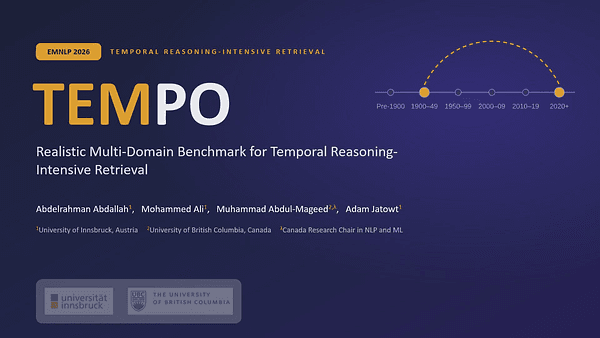
TEMPO: Realistic Multi-Domain Benchmark for Temporal Reasoning-Intensive Retrieval
technical paper

TEMPO: Realistic Multi-Domain Benchmark for Temporal Reasoning-Intensive Retrieval

EMNLP 2026

Muhammad Abdul-Mageed
Mohammed Ali
+1
Abdelrahman Abdallah and 3 other authors

25 October 2026

Stay up to date with the latest Underline news!

Select topic of interest (you can select more than one)

PRESENTATIONS

  • All Presentations
  • For Librarians
  • Resource Center
  • Free Trial
Underline Science, Inc.
1216 Broadway, 2nd Floor, New York, NY 10001, USA

© 2026 Underline - All rights reserved

This site is protected by reCAPTCHA and the Google Privacy Policy and Terms of Service apply.