FROMANNUAL REVIEWS

CogSci 2026

•

•

Rio de Janeiro, Brazil

To better understand the underlying mechanisms of individual and ensemble perception in naturalistic scenes, we compared three bayesian resource-rational models on experimental data (from 27 healthy adults): the 'Individual Encoding Model' (IEM), a variant of the summation model; the 'Ensemble Encoding Model' (EEM), related to the automatic averaging model; and the ‘Task Adapted Encoding Model’ (TAEM), a flexible combination of both models that adapts to task demands. In the experiment, participants encoded and reproduced either an individual object position or an ensemble position (group centroid) in a 3D-rendered scene using a computer mouse. In both tasks, we manipulated set size (3, 6, 10 objects) and presentation time (50, 100, 800 ms). The EEM and TAEM generally explained the human behavioral data best. We conclude that, in naturalistic scenes, the choice between individual versus ensemble perception is likely driven by the more compact scene representation of the ensemble model.
Downloads

Transcript English (automatic)

Next from CogSci 2026

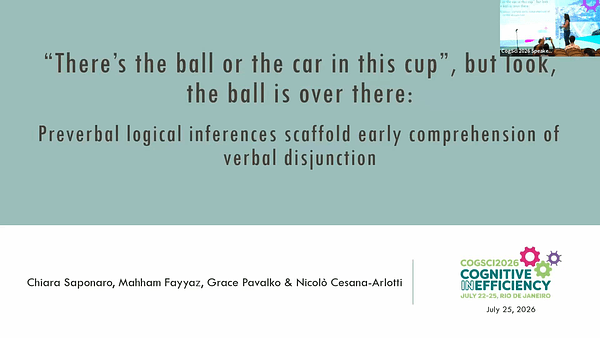
“There’s the ball or the car in this cup”, but look, the ball is over there: Preverbal logical inferences scaffold early comprehension of verbal disjunction

“There’s the ball or the car in this cup”, but look, the ball is over there: Preverbal logical inferences scaffold early comprehension of verbal disjunction

CogSci 2026

+1
Nicolò Cesana-Arlotti and 3 other authors

Similar lecture

Towards Inference Efficient Deep Ensemble Learning
poster

Towards Inference Efficient Deep Ensemble Learning

AAAI 2023

Ziyue Li
+3
Ziyue Li and 5 other authors

10 February 2023

Stay up to date with the latest Underline news!

Select topic of interest (you can select more than one)

PRESENTATIONS

  • All Presentations
  • For Librarians
  • Resource Center
  • Free Trial
Underline Science, Inc.
1216 Broadway, 2nd Floor, New York, NY 10001, USA

© 2026 Underline - All rights reserved

This site is protected by reCAPTCHA and the Google Privacy Policy and Terms of Service apply.