FROMANNUAL REVIEWS

CogSci 2026

•

•

Rio de Janeiro, Brazil

Evidence suggests the US population has polarized over politics in recent decades, as the issue positions of America's ideological sub-groups have moved apart. I use simulations to demonstrate a plausible mechanism by which political polarization can occur among `fully' Bayesian agents. The agents learn from the testimony of competing sources using an empirically-validated Bayesian cognitive model, and do not communicate. Polarization occurs under conditions resembling real-world political debate, and the polarization produced shares several characteristics of real-world US polarization. The core of the mechanism is that agents attempt to infer and account for the bias of the information sources, but doing so creates a feedback spiral where polarized source perceptions drive polarized beliefs and vice versa, unless there is strong disambiguating evidence in one direction or another.

Downloads

Transcript English (automatic)

Next from CogSci 2026

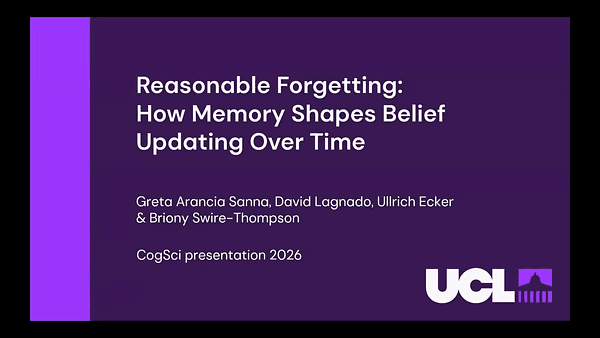
Reasonable Forgetting: How Memory Shapes Belief Updating Over Time

Reasonable Forgetting: How Memory Shapes Belief Updating Over Time

CogSci 2026

+1
Ullrich Ecker and 3 other authors

Similar lecture

Polarization-Aware Low-Light Image Enhancement
poster

Polarization-Aware Low-Light Image Enhancement

AAAI 2023

Chu Zhou
+3
Chu Zhou and 5 other authors

09 February 2023

Stay up to date with the latest Underline news!

Select topic of interest (you can select more than one)

PRESENTATIONS

  • All Presentations
  • For Librarians
  • Resource Center
  • Free Trial
Underline Science, Inc.
1216 Broadway, 2nd Floor, New York, NY 10001, USA

© 2026 Underline - All rights reserved

This site is protected by reCAPTCHA and the Google Privacy Policy and Terms of Service apply.