FROMANNUAL REVIEWS

CogSci 2026

•

•

Rio de Janeiro, Brazil

Human agents constantly exchange information, but deciding which evidence is worth transmitting is a fundamental cognitive challenge. This paper investigates "coherence" as a heuristic for regulating evidence sharing in groups. Extending previous models of individual coherence-based filtering, we employ computational simulations to analyze agents who selectively share evidence based on its coherence with their current beliefs. We find that coherence-based selective sharing is significantly more effective than individual evidence filtering. It helps preserve priors in overly noisy epistemic environments, while still allowing updating when evidence is noisy but truth-conducive. However, this strategy becomes a liability when misleading evidence forms a coherent alternative, steering group learning away from the truth. These results illuminate the conditions under which coherence-based heuristics improve or distort collective inquiry.
Downloads

SlidesTranscript English (automatic)

Next from CogSci 2026

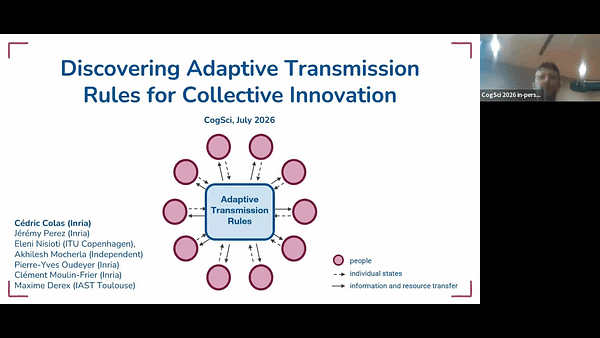
Discovering Adaptive Transmission Programs for Collective Innovation

Discovering Adaptive Transmission Programs for Collective Innovation

CogSci 2026

+1
Cédric Colas and 3 other authors

Similar lecture

Coherence-Based Evidence Filtering: A Computational Exploration
poster

Coherence-Based Evidence Filtering: A Computational Exploration

CogSci 2025

Borut Trpin
Martin Justin and 1 other author

01 August 2025

Stay up to date with the latest Underline news!

Select topic of interest (you can select more than one)

PRESENTATIONS

  • All Presentations
  • For Librarians
  • Resource Center
  • Free Trial
Underline Science, Inc.
1216 Broadway, 2nd Floor, New York, NY 10001, USA

© 2026 Underline - All rights reserved

This site is protected by reCAPTCHA and the Google Privacy Policy and Terms of Service apply.