FROMANNUAL REVIEWS

CogSci 2026

•

•

Rio de Janeiro, Brazil

Without being taught, children learning addition discover strategies that are faster and less error-prone than those in their repertoire. Leading explanations of strategy discovery propose metacognitive mechanisms where children iteratively rewrite their existing strategies. Departing from this tradition, we propose that children make discoveries through a combination of reconstructive imitation during teaching, followed by rational inference under basic performance pressures. We instantiate our proposal with a model of Bayesian program induction with a prior for algorithmic simplicity and a likelihood that first encodes a pressure of mimicry (teaching phase), and then a pressure for speed and/or accuracy (individual practice phase). Regardless of whether the pressure is to respond faster or more accurately, the model robustly captures the long-observed developmental trajectory of strategy discovery.
Downloads

SlidesTranscript English (automatic)

Next from CogSci 2026

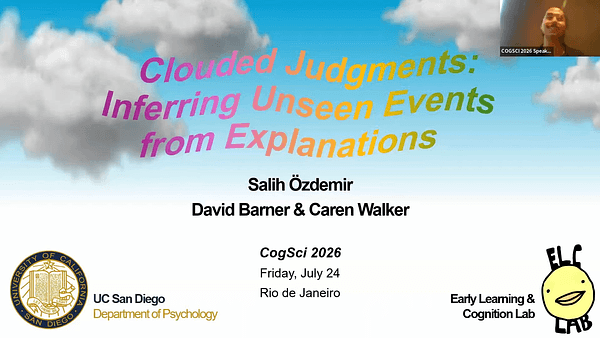
Clouded Judgments: Children and Adults Infer Unseen Events from Causal Explanations

Clouded Judgments: Children and Adults Infer Unseen Events from Causal Explanations

CogSci 2026

David Barner
Caren Walker
David Barner and 2 other authors

Similar lecture

Experience-driven discovery of planning strategies
poster

Experience-driven discovery of planning strategies

CogSci 2025

Ruiqi He and 1 other author

01 August 2025

Stay up to date with the latest Underline news!

Select topic of interest (you can select more than one)

PRESENTATIONS

  • All Presentations
  • For Librarians
  • Resource Center
  • Free Trial
Underline Science, Inc.
1216 Broadway, 2nd Floor, New York, NY 10001, USA

© 2026 Underline - All rights reserved

This site is protected by reCAPTCHA and the Google Privacy Policy and Terms of Service apply.