FROMANNUAL REVIEWS

CogSci 2026

•

•

Rio de Janeiro, Brazil

Human reasoning is often affected by order, such that later judgments depend on earlier ones. For example, order effects have been observed when people answer counterfactual questions. The order in which questions are asked affects whether participants backtrack -- imagining how variables that are upstream of a counterfactual change might have been different. Some counterfactual theories predict backtracking while others do not. We build on this prior work and develop a computational model of counterfactual reasoning that captures order effects. We evaluate different versions of this model on existing empirical results, finding that a model which backtracks and produces systematic order effects best explains human judgments. We conclude by discussing implications of the finding that counterfactual reasoning requires a context-sensitive evidence source for both resource-rational and discourse-coherent explanations of reasoning.
Downloads

SlidesTranscript English (automatic)

Next from CogSci 2026

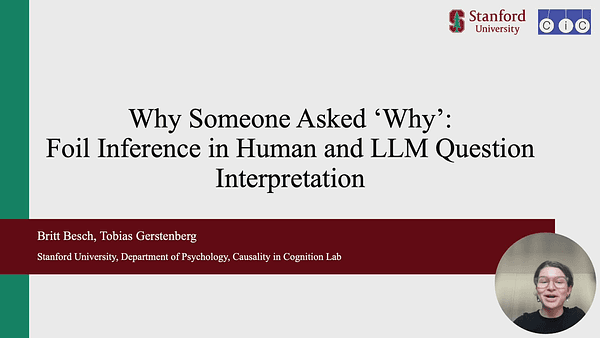
Inferring Why Someone Asked ‘Why’: Foil Inference in Human and LLM Question Interpretation

Inferring Why Someone Asked ‘Why’: Foil Inference in Human and LLM Question Interpretation

CogSci 2026

Tobias Gerstenberg
Britt Besch and 1 other author

Similar lecture

Enhancing textual counterfactual explanation intelligibility through Counterfactual Feature Importance
workshop paper

Enhancing textual counterfactual explanation intelligibility through Counterfactual Feature Importance

ACL 2023

Milan Bhan
+1
Milan Bhan and 3 other authors

14 July 2023

Stay up to date with the latest Underline news!

Select topic of interest (you can select more than one)

PRESENTATIONS

  • All Presentations
  • For Librarians
  • Resource Center
  • Free Trial
Underline Science, Inc.
1216 Broadway, 2nd Floor, New York, NY 10001, USA

© 2026 Underline - All rights reserved

This site is protected by reCAPTCHA and the Google Privacy Policy and Terms of Service apply.