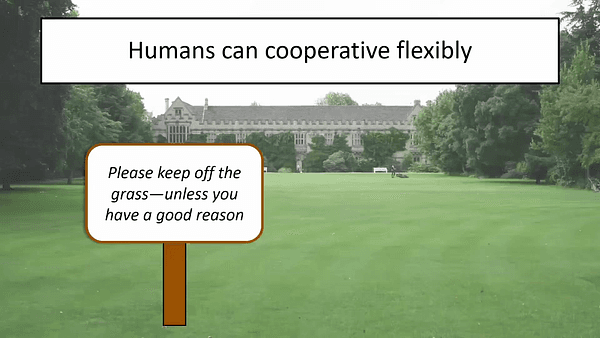
Humans are capable of remarkably flexible moral judgment. Yet societies rely on rigid rules—obligations and prohibitions that apply categorically, even when case-by-case reasoning could yield better outcomes. Why would flexible minds bind themselves to rigid rules? We propose that rigid rules arise to manage ambiguity about legitimate excuses for noncooperation. Such excuses are hard to see from the outside, which lets opportunists mask selfishness as justified hardship. We formalize this idea with an evolutionary game-theoretic model. Two cooperative equilibria emerge: a flexible norm that accommodates legitimate excuses but is vulnerable to exploitation, and a rigid norm that closes this loophole by mandating cooperation even when inefficient. Comparing these equilibria reveals an efficiency–robustness trade-off: flexibility maximizes welfare when trust is secure, whereas rigidity preserves cooperation when trust is fragile. This explains why rigid rules prevail in low-trust settings—interactions with strangers, formal institutions, or tight societies—while flexibility is common in high-trust contexts.