FROMANNUAL REVIEWS

CogSci 2026

•

•

Rio de Janeiro, Brazil

Is child-directed language (CDL) optimized to support language learning, and which aspects of linguistic development does it facilitate? We investigate this question using neural language models trained on CDL versus adult-directed language (ADL). We selectively remove syntactic or lexical co-occurrence information from the model training data, and evaluate the impact of these manipulations on verb meaning acquisition. While disrupting syntax impairs learning across all datasets, models trained on CDL and spoken ADL show significantly higher resilience than those trained on written input. Tracking semantic and syntactic performance over training, we observe a “semantic-first” trajectory, with verb meanings emerging prior to robust syntactic proficiency, an asynchrony most pronounced in the spoken domain, especially CDL. These results suggest that the advantage for verb learning previously attributed to CDL may instead reflect broader properties of the spoken register, rather than a uniquely CDL-specific optimization.
Downloads

Transcript English (automatic)

Next from CogSci 2026

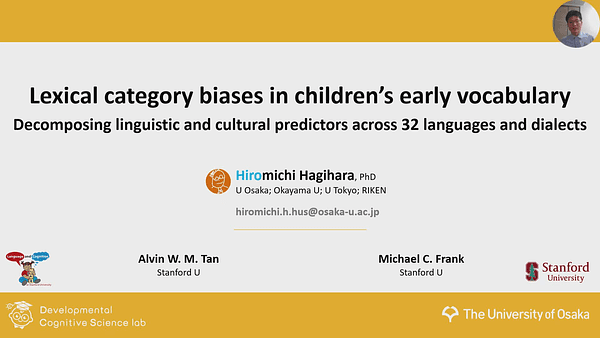
Lexical category biases in children’s early vocabulary: Decomposing linguistic and cultural predictors across 32 languages and dialects

Lexical category biases in children’s early vocabulary: Decomposing linguistic and cultural predictors across 32 languages and dialects

CogSci 2026

Michael Frank and 2 other authors

Similar lecture

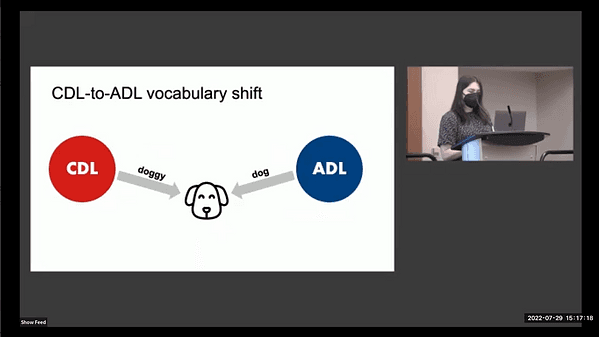
From doggy to dog: Developmental shis in children's use of register-specific words
technical paper

From doggy to dog: Developmental shis in children's use of register-specific words

CogSci 2022

Kennedy Casey

29 July 2022

Stay up to date with the latest Underline news!

Select topic of interest (you can select more than one)

PRESENTATIONS

  • All Presentations
  • For Librarians
  • Resource Center
  • Free Trial
Underline Science, Inc.
1216 Broadway, 2nd Floor, New York, NY 10001, USA

© 2026 Underline - All rights reserved

This site is protected by reCAPTCHA and the Google Privacy Policy and Terms of Service apply.