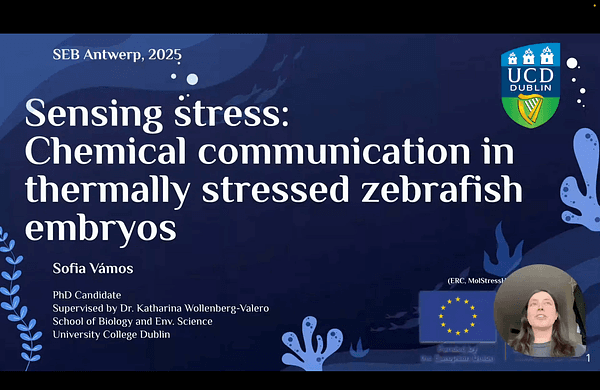
Chemical cues are a major channel of environmental information in aquatic systems. While most research has focused on signals produced during biotic interactions such as predation or injury, recent evidence shows that abiotic stressors, including heat stress, can also induce release of chemical cues that influence nearby conspecifics. These stress-associated metabolites may coordinate group responses and mitigate environmental stress, yet the mechanisms and consequences of such secondary stress communication remain poorly understood. We investigate whether embryos exposed to metabolites released by heat-stressed conspecifics exhibit molecular and phenotypic responses comparable to direct thermal stress. We analysed RNA-seq data from zebrafish embryos exposed during the first 24 hours of development either to heat stress or to stress metabolites produced by heat-exposed embryos. We identified candidate pathways for stress metabolite reception. Comparisons with heat stress revealed overlapping differentially expressed genes associated with muscle development, contraction, and other stress-responsive pathways, indicating partially shared molecular responses between direct and indirect stress exposure. Gene expression changes in metabolite-exposed embryos were also consistent with developmental alterations observed relative to controls. In a behavioral assay at 4 days post-fertilization, larvae exposed to stress metabolites showed reduced startle response compared with controls. The combination of heat and secondary stress produced minimal behavioural responses. Finally, embryos exposed to both heat stress and stress metabolites showed reduced DNA repair capacity following UV exposure. Together, our results demonstrate that heat-induced chemical signals propagate stress to nearby embryos, and can impact their resilience in a changing world.