keywords:
heterothermy
avian energetics
thermoregulation
metabolism
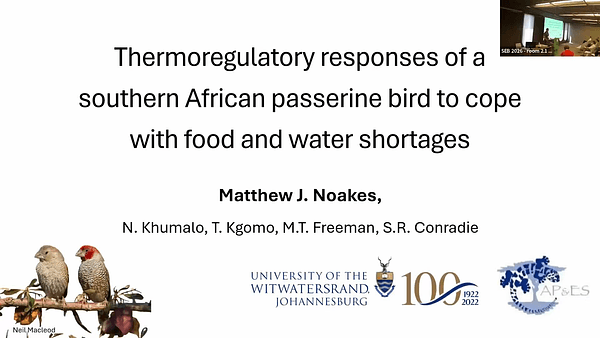
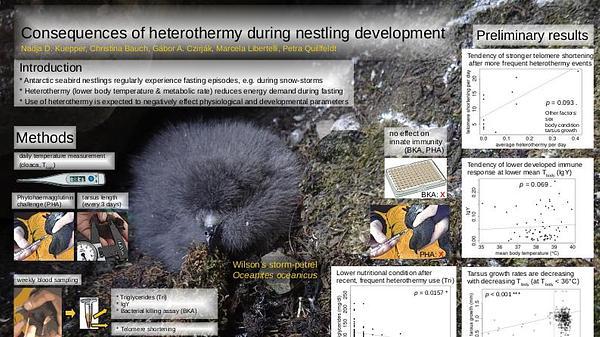
Animals face environmental challenges on a daily basis, while foraging for food, managing their thermal needs, and finding safe places to sleep and raise their young. I am especially interested in how they manage their daily energetic needs given these survival and environmental challenges. One way to study this is to measure how animals allocate their daily energy budgets across various activities, such as in different land use types. And one potential component of this daily energy budget is the ability to modulate their thermoregulatory costs by using heterothermy, where animals lower their body temperatures to save energy. If you have heard of hibernation, that is a form of heterothermy. Birds like hummingbirds can use a daily version of this, called daily torpor, dropping their body temperature by up to 38°C (down to 3°C). I have been studying this adaptation in hummingbirds by integrating ecological data, whole animal energetics, gene expression (transcriptomics), and mitochondrial parameters to understand heterothermy across biological scales. In India over the past two years, my lab and I have started to study comparative avian heterothermy and energetics. But so little is known in the Old World tropics about energy budgets, metabolic rates, and heterothermy. What do we know, what are the gaps, and how do we move forward? I plan to continue to integrate ecology, physiology, evolutionary perspectives, and molecular and imaging techniques to understand how heterothermic animals exist, while training local biologists, and speaking with the public about this work.