Premium content
Access to this content requires a subscription. You must be a premium user to view this content.

Would you like to see your presentation here, made available to a global audience of researchers?
Add your own presentation or have us affordably record your next conference.
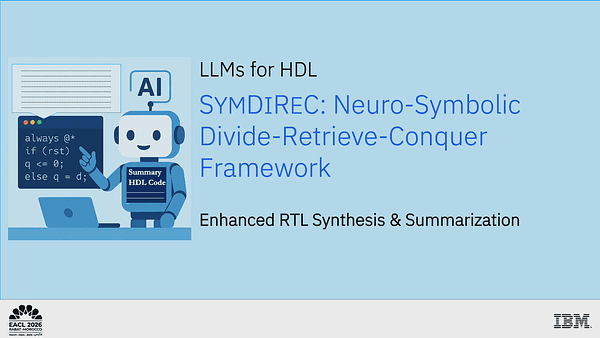
Optimizing Register Transfer Level (RTL) code is a critical step in Electronic Design Automation (EDA) for improving power, performance, and area (PPA). We present CODMAS (Collaborative Optimization via a Dialectic Multi-Agent System), a framework that combines structured dialectic reasoning with domain-aware code generation and deterministic evaluation to automate RTL optimization. At the core of CODMAS are two dialectic agents: the Articulator, inspired by rubber-duck debugging, which articulates stepwise transformation plans and exposes latent assumptions; and the Hypothesis Partner, which predicts outcomes and reconciles deviations between expected and actual behavior to guide targeted refinements. These agents direct a Domain-Specific Coding Agent (DCA) to generate architecture-aware Verilog edits and a Code Evaluation Agent (CEA) to verify syntax, functionality, and PPA metrics. We introduce RTLOPT, a benchmark of 120 Verilog triples (unoptimized, optimized, testbench) for pipelining and clock-gating transformations. Across proprietary and open LLMs, CODMAS achieves ~25% reduction in critical path delay for pipelining and ~22% power reduction for clock gating, while reducing functional and compilation failures compared to strong prompting and agentic baselines. These results demonstrate that structured multi-agent reasoning can significantly enhance automated RTL optimization and scale to more complex designs and broader optimization tasks.