AAAI 2026

January 23, 2026

Singapore, Singapore

Would you like to see your presentation here, made available to a global audience of researchers?
Add your own presentation or have us affordably record your next conference.

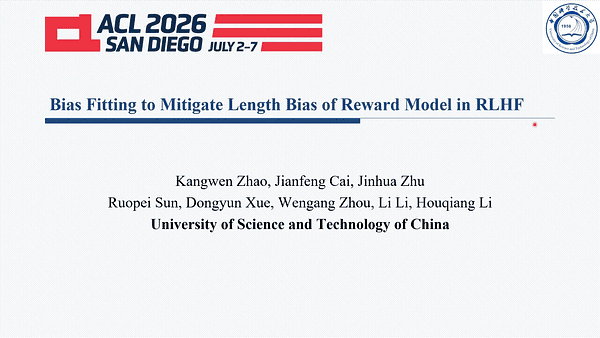
Reinforcement learning from human feedback (RLHF) is widely used to align large language models (LLMs) with human preferences. However, RLHF-trained reward models often exhibit length bias—a systematic tendency to favor longer responses by conflating verbosity with quality. We propose a causal framework for analyzing and mitigating length bias in RLHF reward modeling. Central to our approach is a counterfactual data augmentation method that generates response pairs designed to isolate content quality from verbosity. These counterfactual examples are then used to train the reward model, enabling it to assess responses based on content quality independently of verbosity. Specifically, we construct (1) length-divergent pairs with similar content and (2) content-divergent pairs of similar length. Empirical evaluations show that our method reduces length bias in reward assignment and leads to more concise, content-focused outputs from the policy model. These findings demonstrate that the proposed approach effectively reduces length bias and improves the robustness and content sensitivity of reward modeling in RLHF pipelines.

Downloads

Paper

Next from AAAI 2026

CGMIS: Concept-Graph Based Multi-Hop Instructions Synthesis for Enhancing Long-Context Reasoning
poster

CGMIS: Concept-Graph Based Multi-Hop Instructions Synthesis for Enhancing Long-Context Reasoning

AAAI 2026

+5Wenpeng HuWenliang Chen
Wenliang Chen and 7 other authors

23 January 2026

Stay up to date with the latest Underline news!

Select topic of interest (you can select more than one)

PRESENTATIONS

  • All Presentations
  • For Librarians
  • Resource Center
  • Free Trial
Underline Science, Inc.
1216 Broadway, 2nd Floor, New York, NY 10001, USA

© 2025 Underline - All rights reserved