AAAI 2026

January 23, 2026

Singapore, Singapore

Would you like to see your presentation here, made available to a global audience of researchers?
Add your own presentation or have us affordably record your next conference.

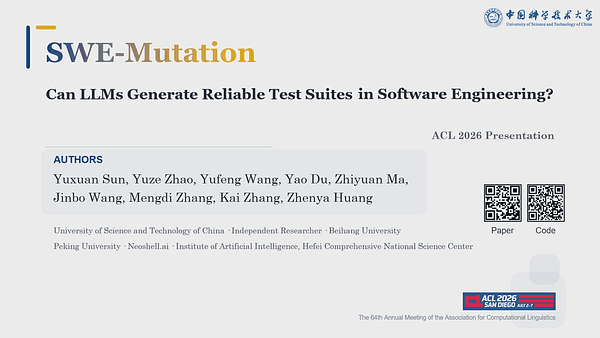
Reinforcement learning (RL) has shown promise for enhancing code generation capabilities in large language models (LLMs), yet its effectiveness critically depends on high-quality test suites for reliable reward signals. Current approaches suffer from inadequate test case quantity and quality, leading to false positives (incorrect solutions passing verification) and slow positives (valid but suboptimal implementations), which corrupt RL training dynamics. We address these challenges through three key contributions: (1) We systematically analyze how low-quality test suites degrade Code RL performance via reward misalignment; (2) We propose Themis, an automated framework that transforms test case generation into code synthesis—first extracting problem constraints via template-guided parsing, then generating executable test generators through LLM-powered code synthesis, and finally validating tests through constraint-aware filtering; (3) We develop an error-guided test case reduction method that preserves error detection efficacy while reducing test set cardinality, thereby enhancing reinforcement learning training efficiency. Evaluated on programming competition datasets, Themis achieves 95\% error detection rates, outperforming original test suites in most of the cases. When integrated into RL pipelines, models trained with Themis-generated tests demonstrate consistent 3-5\% improvements across HumanEval, MBPP, and LiveCodeBench compared to the baseline, matching performance levels achieved with manually curated test suites. Our constraint-aware test synthesis framework ensures full automation while preserving semantic validity—critical for scaling RL training to complex code generation tasks. The framework's modular design also enables seamless integration with existing code data synthesis frameworks.

Downloads

Paper

Next from AAAI 2026

Hallucination as a Computational Boundary: A Hierarchy of Inevitability and the Oracle Escape
poster

Hallucination as a Computational Boundary: A Hierarchy of Inevitability and the Oracle Escape

AAAI 2026

+2
Zenghui Ding and 4 other authors

23 January 2026

Stay up to date with the latest Underline news!

Select topic of interest (you can select more than one)

PRESENTATIONS

  • All Presentations
  • For Librarians
  • Resource Center
  • Free Trial
Underline Science, Inc.
1216 Broadway, 2nd Floor, New York, NY 10001, USA

© 2025 Underline - All rights reserved