Would you like to see your presentation here, made available to a global audience of researchers?
Add your own presentation or have us affordably record your next conference.
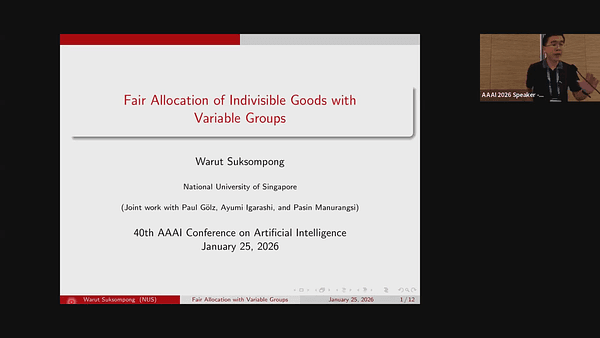
We study the problem of fairly allocating a set of $m$ goods among $n$ agents in the asymptotic setting, where each item's value for each agent is drawn from an underlying joint distribution. Prior works have shown that if this distribution is well-behaved, then an envy-free allocation exists with high probability when $m=\Omega(n\log{n})$ (Dickerson et. al., AAAI'14). Under the stronger assumption that item values are independently and identically distributed (i.i.d.) across agents, this requirement improves to $m=\Omega(n\log{n}/\log{\log{n}})$, which is tight (Manurangsi and Suksompong, SIDMA'21). However, these results rely on non-strategyproof mechanisms, such as maximum-welfare allocation or the round-robin algorithm, limiting their applicability in settings with strategic agents.
In this work, we extend the theory to a broad and more realistic class of joint value distributions, allowing for correlations between agents, atomicity, and unequal probabilities of having the highest value for an item. We show that envy-free allocations continue to exist with high probability when $m=\Omega(n\log{n})$. More importantly, we give a new randomized mechanism that is truthful in expectation, efficiently implementable in polynomial time, and outputs envy-free allocations with high probability, answering an open question posed by Manurangsi and Suksompong, MSS'17. We further extend our mechanism to the settings of asymptotic weighted fair division, and multiple agent types and good types, proving new results in each of these cases.