Content not yet available
This lecture has no active video or poster.
Would you like to see your presentation here, made available to a global audience of researchers?
Add your own presentation or have us affordably record your next conference.
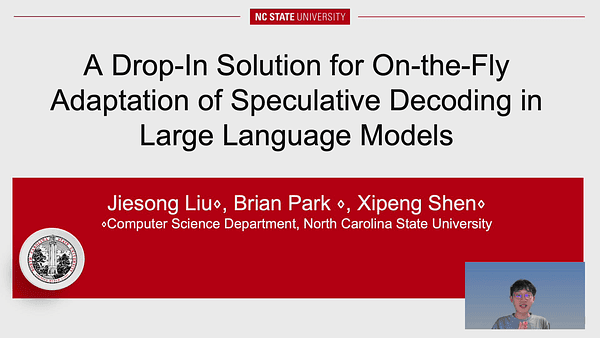
Speculative decoding accelerates large language model (LLM) inference by using a lightweight drafter to propose multiple tokens, which are then verified in parallel by the base model. While effective in English, existing methods often struggle in multilingual scenarios due to static vocabularies and the lack of language-specific instruction data. To address these limitations, we present AdaSpec, a multilingual speculative decoding framework that dynamically adapts both the drafter and vocabulary at decoding time. AdaSpec generates language-specific instruction data using the LLM itself, enabling training of drafters for low-resource languages. It also constructs adaptive vocabularies tailored to each language's characteristics. In addition, we introduce Multi-SpecBench, a comprehensive multilingual benchmark covering seven languages and seven generation tasks, to evaluate multilingual speculative decoding performance. Extensive experiments show that AdaSpec achieves up to 2.3× speedup over the state-of-the-art method of EAGLE-2, even in English, demonstrating its effectiveness across diverse languages and tasks. The implementation of AdaSpec will be publicly available.